“Tyrant at the Head”: Organizers Call Attention to Greene Board Leadership at Meeting
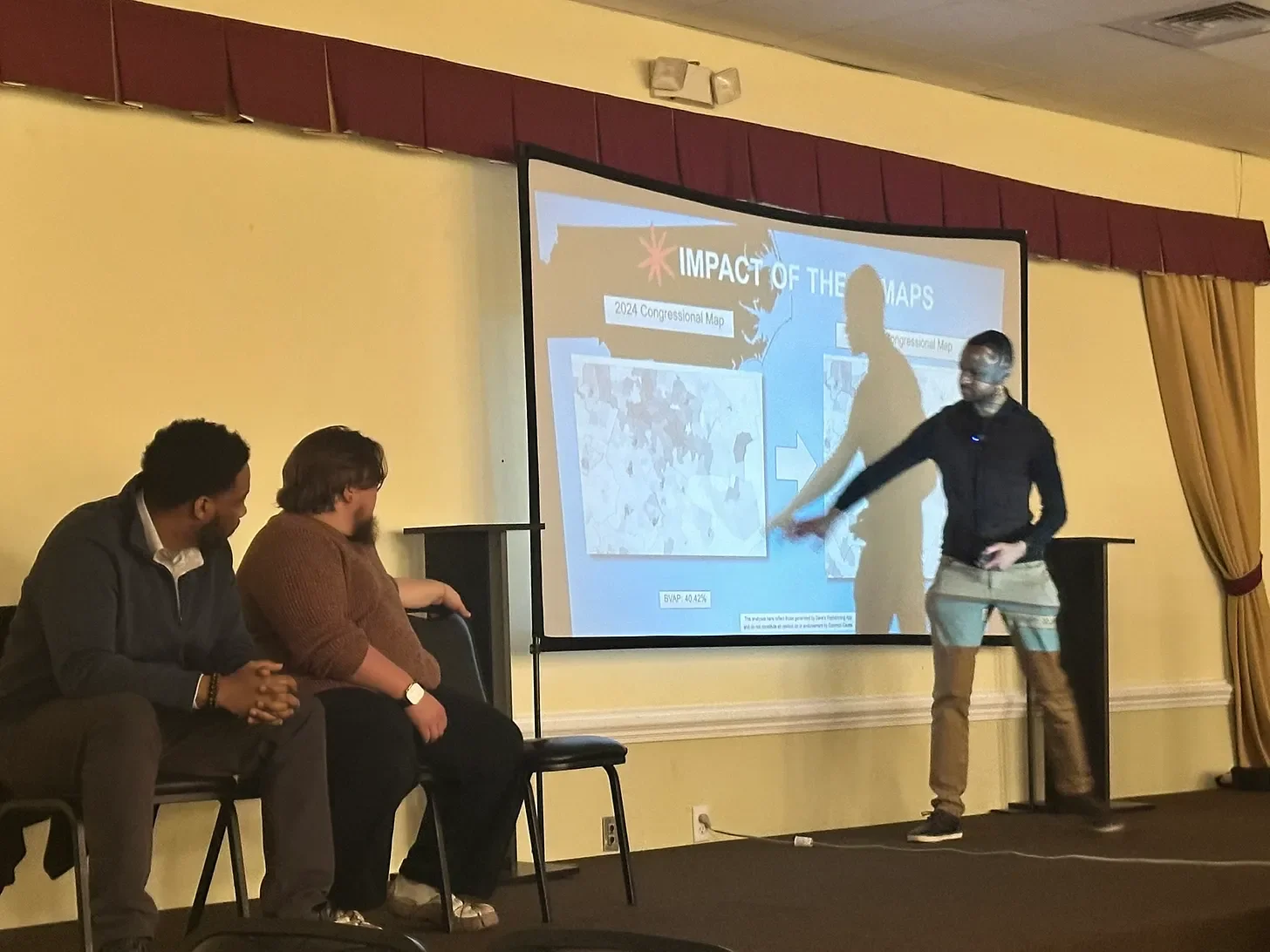
Photo from Derek Burress’s Substack.
Greene County Board Leadership Criticized as “Tyrant” at Meeting on Alleged Local Election Problems and Statewide Redistricting
On Monday evening, January 12, 2026, approximately 30 residents gathered at the Greene County Community Center for a town hall meeting focused on claims by speakers of systematic gerrymandering in North Carolina and how speakers alleged that local election officials had violated voters’ rights.
The meeting, titled “The Road to Fair Maps” and organized by Democracy North Carolina, brought together residents, candidates, and at least one member of the Greene County Board of Elections to examine how recent congressional redistricting has reshaped political representation in Eastern North Carolina and allegations by speakers that local election officials had violated voters’ rights.
Participants included representatives from Common Cause North Carolina, NC Counts Coalition, Black Voters Matter, Power to Vote ENC, and Democracy North Carolina, along with candidates for public office.
“We Intend to Draw Additional Safe Republican Congressional Seats”
Tyler Daye from Common Cause North Carolina opened the presentation with what he described as the central finding of his analysis: According to Daye, North Carolina’s newly enacted congressional maps are projected to result in an 11-to-3 Republican advantage in the state’s congressional delegation, despite North Carolina’s closely divided electorate.
Daye characterized the redistricting process as “a literal conspiracy to hold onto power.” “This is a scandal,” Daye said. “This is being done in plain sight. It’s not some thriller; this is a literal conspiracy to hold onto power.”
The process began in October of 2025 when State Senate leader Phil Berger, House Speaker Destin Hall, and Senator Ralph Hise issued a press release announcing their intention to redraw congressional districts.
Daye quoted directly from that press release: “We intend to draw additional safe Republican congressional seats.”
He described what happened next: “That’s from a press release. A week later, they drew these maps, or Senator Hise drew the congressional map, and they passed the congressional map. I mean, I just think that is remarkable. I mean, no public hearings. I mean, they just said, ‘We’re doing this,’ and then a week later, it’s passed.”
Daye emphasized the explicit nature of the legislators’ statements about their intentions: “The how blatant legislators are in describing their objectives here, I just think that it’s striking to me.”
He compared the situation to other political controversies: “You know, I think all of us have heard about the conspiracy theories about the 2020 election. How many of us have heard about this? Okay, I think everyone is right. You’ve heard about it. Well, there’s no evidence of voter fraud or anything that happened. We’ve got Senator Hise on stage saying, ‘This is about partisan gain. I’m doing this because President Trump said that we need more Republicans.”
Redrawing of Congressional District 1
The centerpiece of Daye’s presentation focused on Congressional District 1, which previously included Greene County and had been the only truly competitive congressional district in North Carolina.
Daye displayed precinct-level maps showing the demographic composition of the district before and after redistricting.
“This is showing you the Black voting-age population, and the darker the shading, the higher the Black voting-age population,” Daye explained. “Each of these shapes is a precinct, and when you look at this, the district really is centered around the northeast part of the state. It does come down here into Greene County and Wayne, Nash, Edgecombe, and so forth, but it takes a good portion of the Black Belt in this part of the state.”
Under the new map, Greene County (along with Lenoir, Wayne, and Wilson counties) was removed from Congressional District 1 and placed into Congressional District 3. Meanwhile, several counties further south and east — including Carteret County, Beaufort, Craven, Dare, Hyde, and Pamlico — were added to District 1 from District 3.
“The new map still maintains much of this area, and Greene County is now out of that district in District 3. But the big change here is that areas further south and east are now included in the district, areas like Carteret County, for example,” Daye said.
He highlighted the geographic absurdity: “I do not know many people in Carteret County that would say, ‘Oh yeah, Oxford, Henderson, that makes sense way over here.’ So yeah, those areas are now the same congressional district.”
Later in the meeting, Lucas Seijo of Democracy North Carolina noted that he had personally driven from New Bern to Oxford to speak with constituents, a trip that took two and a half hours entirely through Congressional District 1. The district now connects communities with vastly different economic needs and interests.
The Demographic Impact
According to Daye, the redistricting resulted in a significant reduction in Black voting power within District 1.
“So essentially what this is showing you is a dilution of the Black voting age population from a district that was 40 percent to a district that is just 32 percent now,” Daye said.
He explained why this 8% reduction matters: “And the significance of that is that we have evidence of racially polarized voting taking place in this part of the state, and this is showing it to you, basically.”
Claims of Racially Polarized Voting Presented
Daye presented detailed data from the 2024 elections to demonstrate why district composition is critical in Eastern North Carolina.
“This is showing you the election results based upon race in congressional district one in the previous district,” Daye said. “This is showing you here how white voters voted. This is for the race between Lindsay Buckhout and Don Davis.”
(During the presentation and discussion, speakers repeatedly referred to Republican challenger Laurie Buckhout as “Lindsey” or “Lindsay,” reflecting the language used in presentation materials and spoken remarks.)
According to Daye’s presentation, the voting patterns he presented reflected what he described as stark racial polarization:
According to Daye’s data, among white voters, Lindsay (Laurie) Buckhout won 87% of the vote
According to Daye’s data, among Black voters, Don Davis won 98% of the vote
Daye claimed the data illustrate racially polarized voting patterns in the district.
The 2024 Presidential Race
Daye then turned to the presidential contest, noting that the racial divide was even more pronounced.
“This is showing you the presidential race. It was even more stark,” Daye continued.
According to Daye’s presentation, the presidential race showed similar patterns:
Among white voters, President Trump won 91% of the vote
Among Black voters, Vice President Harris won 98% of the vote
Daye explained the significance of these voting patterns for understanding the impact of redistricting.
“So why am I showing you this? What’s the significance? What it shows is that in this part of the state, there is a stark difference between the preferences of white voters and Black voters,” he said. “And when you have a district that is drawn or a district that’s not drawn in a way that gives Black voters an opportunity to elect a candidate of their choice, white voters are always going to overshadow the Black voters, essentially.”
He continued: “So you need a district that allows for Black voters to be able to elect a candidate of choice. If white voters were voting more with Black voters, it would not be an issue. But that is just not happening in this part of the state, and that’s the significance there.”
Daye noted that, despite the clear racial impact reflected in the data, legislators have said they did not consider race when drawing the maps.
“I will tell you, Senator Hise and his colleagues say that they did not look at any racial data when they drew this map,” Daye said. “We don’t know what data they looked at, honestly, as they won’t tell us. But even if they did not, the impact is clear.”
Senator Ralph Hise: The Architect of the Maps
Throughout the presentation, Senator Ralph Hise was identified as the central figure in the redistricting process, and his image appeared repeatedly on slides.
Daye quoted Hise’s own statement about the purpose of the maps: “This is Senator Hise,” Daye said. “He himself said that ‘they should perform to elect 11 Republicans.’ So, I mean, you can’t get clearer than that what the goal is here.”
Hise’s image was shown multiple times during this portion of the presentation. Gesturing toward an image of Hise, Seijo told the audience, “If you ever just want a face of the enemy, and I am not talking partisan enemies, I’m talking about persons who are really just trying to silence us, there it is,” he said, gesturing to Hise’s photograph.
Later, when Hise’s image appeared again on screen, Seijo apologized with evident frustration: “Sorry to make y’all see Senator Ralph Hise again,” Seijo said. “It’s not a pretty sight, but, you know, that’s okay. That’s on me. I just wanted y’all to see him again. That’s all that was.”
Daye summarized the outcome of Hise’s work: “Congressional District One was again the only truly competitive congressional district in the state, and at this point, our districts have now been drawn in a way where there is a predetermined outcome where, you know, Senator Hise and the map drawers have drawn it for 11 Republicans and three Democrats.”
The Failed Legal Challenge
Seijo then addressed the recent legal efforts to block the new congressional maps from being used in the 2026 elections.
He explained: “There was an injunction that was asked by a couple of our partners across the state, reaching out to a three-panel judge looking for an injunction on these maps for the 2026 elections. And it was really done to challenge the congressional district 1 and congressional district 3 remaps and just make sure that we didn’t have these maps in place for this upcoming election, that people have their voices heard.”
According to Seijo, the legal arguments presented to the court included:
• The maps constitute illegal partisan gerrymandering
• They result in racial gerrymandering and discrimination
• They represent First Amendment retaliation against voters
Seijo characterized the arguments as strong: “Really just great responses as to why these maps should not be used. Why these maps are, you know, go beyond partisan gerrymandering and are leading to racial gerrymandering and racial discrimination. You know, we have First Amendment retaliation because people are voting for Don Davis, for people they want. And the General Assembly said, ‘We don’t like that.’”
The three-judge panel denied the request for an injunction.
Seijo stated the outcome: “And the long and short of it is that the three-panel judge heard this request for an injunction and then denied it. So these are the maps that we will be having in 2026 unless it’s an act of God takes place sometime soon.”
He added: “And the three-panel judge says, ‘No.’ So that’s that. Fair courts all around are important.”
Seijo’s comments made clear that the denial means the new maps will remain in effect for the 2026 elections. The redrawn districts, including the change to Congressional District 1 that reduced its Black voting-age population from 40 percent to 32 percent, will be used as drawn following the court’s denial of the injunction.
The Critical Role of State Supreme Court Elections
Daye spent considerable time explaining how North Carolina reached this point and why judicial elections matter for redistricting.
“There was a time just a few years ago in 2022 when partisan gerrymandering was illegal in North Carolina,” Daye said. “So the state Supreme Court ruled that. The state Supreme Court also ruled, as I said before, when they reheard the case and said partisan gerrymandering is permissible.”
The change in the court’s position came after changes in the court’s composition following elections.
Daye provided specific examples showing just how close recent State Supreme Court races have been.
“We do elect State Supreme Court judges in this state. So I would encourage you to vote in those elections. You know, do your research on the candidates. And just to tell you how impactful these elections are, just last year, we had an election between Justice Allison Riggs, who was on the court and still is on the court. She won in a race against Judge Jefferson Griffin by 734 votes, and that’s out of over 5.5 million, which I just think is remarkable.”
He emphasized this was not a one-time occurrence: “And you would say, well, that’s a fluke. Well, it also happened when Cheri Beasley lost to Justice Paul Newby in a race that was decided by just 401 votes. That was another state Supreme Court race. So we’ve had two state Supreme Court races in which over 5 million people have cast ballots, and they’ve been decided by just hundreds of votes.”
Daye concluded: “I don’t think that’s a crazy suspense. It could happen again. So your vote has a lot of power. And again, when it comes to the state Supreme Court, it could be the difference between allowing more of this partisan gerrymandering nonsense and actually ending it.”
Historical Context: Senator Berger’s Reversal
Daye provided historical context that illustrated how partisan interests have shaped positions on redistricting reform.
“Back in 2009, Senator Berger was in the minority, and at that time, Democrats were in the majority. Senator Berger actually sponsored an independent redistricting commission bill, and at that time, Democrats didn’t want anything to do with it,” Daye said.
He characterized the pattern: “It’s like a game of musical chairs. When Berger’s in power, oh, the system’s fine. Democrats are all about it. So again, if you do see a change, then it’s important to make sure that we are holding people accountable for what they said that they were going to do.”
Seijo later added to this point: “This game of musical chairs has gone on long enough. It’s not fun anymore. No one’s having a good time. At the end of the day, there’s one loser, and that’s all of us.”
Concerns Raised About Redistricting Data Transparency
Kyle Brazile, director of civic engagement for the NC Counts Coalition, addressed a critical obstacle to transparency and accountability in the redistricting process.
“A year or so ago, they passed a law which stated that redistricting records that they have is no longer public record,” Brazile said. “So these are no longer records that we have access to as the people in North Carolina. We don’t know what people are doing behind closed doors. We literally can’t get that information anymore because it’s not public record.”
He characterized this as fundamentally anti-democratic: “So it just adds on what you said. They are behind closed doors in the dead of night, doing the things that shouldn’t have been done. That is not what government is supposed to be. That is not what government should be.”
Speakers argued that the lack of public access makes it difficult for citizens to know what data informed the redistricting decisions.
Despite the lack of transparency in the current process, Brazile referenced a previous redistricting effort that did include limited public comment periods.
“When they went through, and they redistricted back in 2023, you know, back room, and then we had two or three hearings, 12,000 people sent a comment,” Brazile said.
He cited analysis showing the overwhelming direction of public sentiment: “Representative Pricey Harrison’s office analyzed the comments and found about 97 percent or so of the comments were against gerrymandering.”
Brazile also cited broader polling data: “Eighty-four percent of North Carolinians across political ideology, they don’t like gerrymandering.”
He proposed a strategy: “We have to make this so toxic that people don’t want to touch it.”
Allegations Concerning Greene County Election Administration
Midway through the meeting, during the audience question period, the conversation shifted from statewide redistricting to allegations of serious problems with election administration in Greene County.
Wanda Hunter from Black Voters Matter described an incident reported to a voter protection hotline.
“Greene County has some issues with the board of elections, with their poll workers,” Hunter began. “And we had an issue that was reported to the hotline of somebody who was not offered a ballot and an ID exception form.”
She explained what happened: “And we had that issue come up here in Greene County, and the man was advised by the chief judge that, because he knew him, he said, ‘You have enough time to go home and get your ID.’”
Under North Carolina law, voters without photo identification have the right to request an ID exception form and cast a provisional ballot. Poll workers are required to provide both when requested.
“They should never be advising you,” Hunter said firmly. “It is legal for them to provide you with the form that you ask for. They do not operate in an advisory capacity. It is their responsibility, and it is within the law that they provide you with those provisional ballots and ID exception forms.”
Hunter emphasized the potential consequences: “And the man that left, if he went home and his battery died in his car and he was not able to make it back to the poll, that would have been one person that lost their vote. And we know that there were some races that were on that ballot that were decided by about four or five votes.”
Hunter did not let the violation pass without action. She brought the issue directly to a Greene County Board of Elections meeting.
“And yeah, so, and at this point in time, I’ve spoken at the county board of elections, and the board chair says that I questioned his integrity,” Hunter said.
Her response was direct: “And I do question your integrity when you put somebody’s ballot on the line, and you violate their legal obligation to cast their ballot, and that’s what happened at that point in time.”
Hunter made clear this was not an isolated problem unique to Greene County.
“So it’s not only happening here in Greene County, but we’ve seen it in other counties where people are not having their ballot counted,” she said. “And it’s not only happening here, but it’s happening other places in North Carolina also. Many of you may know that there’s an issue in Carteret County right now, and their municipal election has been moved to March. It’s the primary.”
The Carteret County situation was described by Hunter as particularly significant, stating that an entire mayoral election had to be held again due to provisional ballot violations.
Hunter later added an ironic observation: “And you know who’s complaining about that? Republicans, the same Republicans that put Republicans in charge of offering provisional ballots, who did not offer provisional ballots.”
Hunter stressed that the problem stems from inadequate training of poll workers.
“So make sure that that is known, and if you have any issues, a lot of times, we do have poll workers that are outside or observers that can help you navigate whatever is going on. I luckily happened to be in place at that point in time and was able to call what we have, a legal number, and report it to the lawyers that we have. And they took it to another level,” Hunter said.
She concluded: “But the county board, the board of elections, he was way out of pocket. And so, at this point in time, we need poll workers, because if they’re not fully educated, then they will give people the wrong information.”
After Hunter finished speaking, Seijo acknowledged Hunter’s concerns about election administration during the question period and alleged what he described as deeper institutional problems within the Greene County Board of Elections.
“There actually is a problem with the Greene County Board of Elections,” Seijo said. Seijo did not provide specific evidence to support the claim. “That’s a conversation for a separate time, and if you really want to get into it, I invite you to speak with Ben, Mr. Ben Lanier up here, and Mr. David Jones can tell you all about it.”
Seijo then used a charged phrase, though it was unclear to whom he was referring: “Outside agitator, member of the Board of Elections for Greene County, but that is a conversation for a separate time, and something that we actually have a program for that we’ll be talking about.”
Later in the meeting, when discussing action steps for community members, Seijo returned to the Board of Elections issue with even stronger language.
He began by explaining the broader context of election administration challenges ahead: “Right now, 2026, there’s going to be battles this year with this outcome, especially with the county board of elections composition changing and the state board of elections composition changing. We are going to see battles here over how our elections are determined, whose votes count and so on and so forth.”
Seijo then highlighted Greene County’s specific problems: “So please, Greene County, you’re so important. There was only 12 counties that did not pass, that did not have unanimous early voting plans for this early voting, for this primary election, and one of those counties is Greene County.”
He added: “In fact, we had too many in the east. For some reason, Greene County was one of the counties that had a non-unanimous plan. And so they are making, and so the state board of elections has to keep control over that. And quite honestly, the state board of elections is not that nice either. And that’s being nice to them. I don’t talk a lot worse about them, but they’re not so nice to say the least.”
Then Seijo made his most direct statement about Greene County’s Board of Elections leadership: “There is a tyrant at the head of the Board of Elections in Greene County, and he does not like what Wanda just mentioned either. So we need people out there to hold him accountable. Hold his feet to the fire.” Seijo did not name the individual or provide evidence to support the claim, and no formal complaints, election protests, or appeals of provisional ballot decisions have been filed with the Greene County Board of Elections.
He urged community members to attend Board of Elections meetings: “First is, please, please attend and monitor your county board of elections. Also, just do some morale for Ben and make sure David has some friends there in the gallery, the peanut gallery.”
Vote Protection Programs
Hunter and Seijo both described vote protection programs available to help ensure proper election administration.
Seijo described how the programs work: “So what we do in response to that is monitor. North Carolina Black Alliance, Black Voters Matter, and other organizations across the state have vote protector programs, where we have poll monitors that go out, offer information, offer the literature like this back there, and monitor to make sure if there’s any issues that we’re calling our hotline that’s staffed by legal expertise, some of the best minds in the state when it comes to elections and voting, and they’re checking with them.”
He explained the escalation process: “And if there are issues, they’re reaching out to the Greene County Board of Elections, and if it goes on from there, they’re reaching out to the state board of elections and getting these issues resolved.”
Seijo encouraged participation in multiple ways: “But if you want to take part in that, first off, we always need poll workers. We always need poll workers, and we need good poll workers. So that is one option. If you do not have the availability to be a poll worker, take a shift and be a vote protector.”
Ben Lanier on National Stakes
Ben Lanier, a member of the Greene County Board of Elections, spoke from his seat in the audience during the question-and-answer segment discussion about why the congressional redistricting matters beyond North Carolina.
“I had to tell people why it’s so important that the congressional seat is so important. Really, President Trump said it best in a commercial a few days ago,” Lanier said. “When you talk about voter education, I have to let people know why you need to make sure that you go out and each person that you voted for, why that congressional person is so important to what the President is trying to do.”
He explained the broader implications: “So I try to make sure that you understand what’s going on, not just only just say, this district and that district. How did that district affect you? That district don’t just only affect you. It affects the whole country.”
Lanier connected congressional control to presidential accountability: “Don Davis, right now, if he don’t get it, one other thing that’s going to be left out is the Speaker of the House and the President said if they get it, they’re going to impeach me. And he knows that. He knows that he’s doing a lot of crazy stuff up there now.”
He then connected this to the current power dynamics in Congress: “Why is it that we trying to get you may not agree with Don Davis or whatever, and there’s still none. I’m trying to keep it non-partisan, but this district one and district three, what they’re trying to do, if the President call for that, he wants to keep the Speaker of the House. So regardless what you say if you don’t like this Democrat, this is it. And if they strip that, when you come down to the Speaker of the House, you have the Democratic Party. Have no say so at all. You be just like Hakeem Jefferson right now. He get on TV, he can say everything, but he can’t do a thing.”
(Note: Lanier appears to have misspoken when referring to House Democratic Leader Hakeem Jeffries, who has served as House minority leader since 2023, calling him “Hakeem Jefferson.”)
Lanier emphasized the global reach of congressional decisions: “He can see every little thing that congressional district is doing. When they stop feeding people over there in Sudan, that congressional district has an effect on that. Anything that you’re looking at on TV, that has people all over the world, congressional district has something to do with, and we need to express that to the people who don’t vote.”
He stressed the importance of education over simple appeals to vote: “But so we have to make sure we educate and get people out to the poll and vote and understand. You got to make sure you understand what’s going on. At least part of that person understands part of what’s going on.”
Lanier also addressed voter participation rates: “There’s enough people who did not vote. So as Obama always says, what can we do to get somebody out to vote and take it very serious. You’re already behind, but the people who stay home need to get out and vote.”
Jess Rivera: The Legislative Reality and Path Forward
Jess Rivera, a Democratic candidate for State Senate District 4 running against incumbent Buck Newton, addressed a question about what Democrats could have done to stop the redistricting.
She began with full disclosure: “My name is Jess Rivera, and I’m not trying to hijack a non-partisan moment. I am a partisan candidate for the Democratic State Senate of District 4, which is Greene, Wayne, and Wilson County. So I will be running against Buck Newton now. Buck Newton is a Republican state senator who voted for these maps.”
Why Democrats Were Powerless
Rivera explained the stark reality of legislative supermajorities: “So formally, the answer to your question is, Democrats could not do anything because there’s a supermajority in the Senate. And Dante Pittman, out of Wilson County, was the only house district member that broke the supermajority in the House for our general assembly.”
She continued: “So the plain, cold, hard answer is Democrats couldn’t do a darn thing. How some of the legislation works is it has to go through committee first to even hit the floor. The committees are also overrun by Republican representation, because they have dual supermajorities, until there was Dante. So again, our legislation cannot even get to the floor for a vote. It dies in committee.”
Rivera shared her experience with a different system:
“How we get to the answer of having a nonpartisan, not bipartisan, nonpartisan citizen group that goes through a set of training, just like anybody else does on a jury trial, and then chooses based off of the numbers that have fair representation for our communities, is by electing people who want that.”
She made her own position clear: “Now I’ll shamelessly pull the plug and say I want that. I’m originally from California. Out there, we have a non-partisan committee. It’s one of the most fair maps that are drawn in the entire nation, and Republicans actually have a say in their agricultural rural areas of California, and it works.”
Rivera connected redistricting to broader transparency issues, specifically citing her opponent’s record: “Buck Newton introduced legislation that takes away transparency of government. The emails that belong to you as taxpayers do not belong to you anymore. They are on retail to the highest bidder from that legally elected official, that legislator, who can sell their data to whoever they want.”
Despite the gerrymandering, Rivera offered an encouraging analysis: “Now, what I saw in those numbers was 13 in CD 1 and 14 in CD 3. Fascinating fact during the most recent special elections, the overall average of change of voters going from Republican to Democrat, 13 percent ladies and gentlemen.”
She concluded: “CD 1 and CD 3 are within grasping distance if we get active. We can now take two of them instead of surrendering the one we barely got. So that’s our answer to getting there. And it takes this entire year, all the way till November 3, electing people like myself, getting Buck out of there.”
The Path to Independent Redistricting Reform
Daye outlined the concept of an independent redistricting commission as a long-term solution to gerrymandering.
“There are really three main questions that you have to answer when it comes to the process. That’s who draws the maps, how the maps are drawn, and who approves the maps,” Daye said.
Under the current system: “Who draws the maps? It’s the redistricting committee chairs and really their aides and consultants. In this case, for this congressional map, it was just Senator Ralph Hise. Sometimes it could be some aide that is hired to do it, but essentially, it’s the legislative leaders deciding how that’s going to work.”
He continued: “How are the maps drawn? What is the criteria for them to actually come up with this map? Well, it’s however the redistricting or the legislative leaders want, how the chairs of the redistricting committees want, and that is influenced by the leaders in the General Assembly.”
And finally: “Who approves the maps? Well, it’s the state legislature that approves the maps.”
Daye summarized: “So, you know, I mean, this is a process that is just completely controlled by people who are politicians that want to remain in power and keep their party in power.”
How an Independent Commission Would Work
Daye described an alternative approach: “Who would draw the maps? You would have a citizens commission. Citizens, not politicians. You’d have an equal number, five Republicans, five Democrats and five voters not affiliated with the two major parties.”
The commission would operate differently: “How would the maps be drawn? The commission would have to follow strict criteria designed to prioritize voters and respect communities of interest. Because the whole purpose, I think, of drawing these districts, if you actually go back to the founding of the country, and why we do this, why we have a representative democracy, is that we have representatives that represent their communities.”
He pointed out the absurdity of current districts: “It’s not having Morehead City in a district with Oxford, or in my case, Greensboro and Banner Elk in the same district.”
Finally: “Who approves the maps? Well, the Independent Commission would approve the maps, and so you would not have the legislature controlling any part of this process.”
Daye noted: “There are other states that have implemented independent commissions, like Michigan, Colorado, California, and the process has worked much better.”
“There have been bills introduced, House Bill 20, Senate Bill 638, which is the same bill, just the House version and the Senate version, and Senate Bill 698, those are all independent redistricting commission bills,” Daye said.
Marcus Thompson: Beyond Partisanship to Democracy
Marcus Thompson, organizing director for Democracy North Carolina, emphasized that redistricting reform transcends party politics.
“My name is Marcus Thompson. I’m the organizing director for Democracy North Carolina,” he said. “And one thing I just wanted to say in this space, I appreciate all the comments. A lot of times, conversations like this, they start to get broken into parties, and I definitely appreciate what you’re saying about party labels and things. But I think when it comes to redistricting and when it comes to gerrymandering, I think the point that NC Counts is making, it’s about representation.”
He stressed the nonpartisan nature of the organizations: “Democracy North Carolina is a nonpartisan organization, all these organizations here are, and what we care about is communities are able to elect people that truly represent them.”
Thompson cited the broad opposition to gerrymandering: “And when we have these situations, you gave us that 84 percent of people don’t like gerrymandering. If you’ve got 84 percent of people in North Carolina, you’ve got Republicans in that, you’ve got Democrats in that, you’ve got independents in that. And I just want you guys to know in this room, we’ve got Republicans, we’ve got independents, we’ve got Democrats.”
He articulated what should unite people across party lines: “And so the hope is that people of every party would say, I care more about my democracy functioning properly. I care more about the state of North Carolina and what’s best for the people there, than what’s best for my party.”
Thompson noted that gerrymandering harms everyone: “When you’ve got a map drawn where the new maps that are drawn, those don’t help Republicans in the coastal areas that have to have representation in the middle of the state, that’s not helping them out either. It reduces people down to just their party, and everybody in this room is more than just their party. Everybody in this state is more than just their party, and we deserve fair representation.”
He concluded: “So it’s up to us. I think if we can expand our conversation, we can expand our focus, not just on the people we know, but not just the people who we know agree with us on all these other issues, but if we can get people to agree that we want democracy in this state. We want fair representation, period, regardless of the party, and then let the best man win, let the best person win, let the best policy win, let democracy win.”
Community Organizing and Education Strategies
Several speakers addressed practical strategies for engaging communities and connecting redistricting to everyday concerns.
Byron Laws, Assistant Director of Civic Engagement for NC Counts Coalition, emphasized the importance of making political processes relevant to people’s lived experiences.
“One of the things I just wanted to bring up in the space is in regards to how do we make this happen, and just voter turnout,” Laws said. “I think one of the things that we also have to highlight is connecting the people to the issues.”
He provided concrete examples: “We just recently went through the issues with SNAP benefits being cut during the government shutdown. Who in your area was a part of that? Really doing the work to figure out who might have represented me, who may have actually had a piece in how what happened there, what that looked like, and how did they get into the position they’re in?”
Laws suggested starting locally: “So when it comes to education, where do we start? Is there a local PTA for the school, the school board itself, and then going from there to see who actually in my community is making the decisions around how my children or grandchildren are being educated? Who’s making that decision?”
He noted current issues affecting communities: “Also, we don’t have a state budget right now, so there are resources and things you all need that you can’t get here because there are people in power who have not come together to make a decision on passing a state budget so that those resources could be allocated to you all. Finding out who that person is, or who these people are that sits in these positions that are hindering me from getting the services that I need for my family or friends, things of that nature.”
Laws encouraged building from existing community networks: “And so then figuring out my group is here. I tap my girlfriend, my longtime classmate to be here. So then how do you bring your children here or your grandchildren or your niece and nephew? Because you all are part of a certain group of cohorts. You all are similar age, but then that’s a whole group of generations under you all that needs to be here as well.”
He acknowledged the historical commitment of those in attendance: “There is no reason why you all are outnumbering young people here in this community. Don’t think that it doesn’t go unnoticed. Don’t think we don’t appreciate the ground that you all paved, because we do. We also want to do whatever we can to take that energy, that knowledge you all you all have, so we can pass it to those under you all, so we can still get the things you all deserve.”
Meeting People Where They Are
Seijo shared an example of innovative community organizing from another Eastern North Carolina county.
“I have a friend down in Duplin County, and she runs a program where she used to be a beautician, and so she has a program where she has barbers and beauticians come to her, and she educates them on political work and political education, things like that,” Seijo said. “And she gives them literature to where, when they are working with clients, they’re able to have conversations with them about voting or hand them literature.”
He explained why this approach works: “And it’s stuff like that. That’s great. Yeah, it’s stuff like that that’s going to make the difference, because, you know, who are you going to trust? You’re going to trust your barber and your beautician. And I hope so, because if they mess up, you’re going to really not trust them moving forward. So they want to make sure that they’re giving you good information as well about politics and things like that.”
Seijo emphasized the organization’s commitment to ongoing engagement: “So, you know, we’re happy to work with you on that. We’re not saying that you’re on your own. You know, we’re coming out here tonight, but I live and work in Eastern North Carolina. You can ask a lot of people in this room. You’ve seen me around in different areas, so I’m happy to work with you. You know, Tyler and Kyle, they braved the trip from the triad out here. So they done it once, they’ll do it more. And I’ve learned that anything I ask for, they’ll do. So if you all ask me, and if I ask them really nicely, they might do it. But that’s to that point.”
Engaging Young Voters
Charisma Warren (name not verified) from Power to Vote ENC, which registered over 12,000 voters in three months during 2024, addressed the challenge of engaging young people and minority communities.
“My name is Charisma Warren. I’m with Power to Vote ENC. Yeah. I’m also a nonpartisan voter registration organization, and we service everyone,” Warren said. “So what our organization does is go into the community and register citizens to vote.”
She described a common problem: “Over this past year, 2024, we registered in three months, we registered over 12,000 people within our communities. The thing I see the most is in our minority communities, within our minority communities and with our youth, they feel like their voice has no power, like their voice don’t count, don’t matter. But I tell them, it does.”
Warren acknowledged the challenge young people face: “But when they see the news and see things, you know, with their own eyes, and hear. You know, this generation is a generation of feeling entitled. So they feel like, okay, if they’re not going to do anything, we’re going to do things our way, and we’re not going to vote and do things that they feel like we should do.”
She proposed a solution leveraging family networks: “So I’ve asked grandparents, anyone in here grandparents? I’m a grandparent. I’m a grandmother of six wonderful, beautiful grandbabies and a mother of four, and what I’m going to do this year is challenge my grandkids as well as my kids.”
Warren explained her approach: “We all have kids and grandkids. They’re always wanting something, asking us for money. They’re always on social media. Ask them to utilize their social media time, their talents, to encourage youth to vote, to encourage their family and communities to vote. Let’s start that trend with our grandkids and with our kids.”
She emphasized meeting young people on their terms: “For starting 2026, we have the power within our hands to be that footstool, that stepping stone, to push them out there so that they can see. Also, another thing we have to educate them on their level. They don’t understand the big terms that we use of how it’s truly impacting them and affecting them. But a lot of them are influencers. A lot of them don’t see the bigger picture or how it’s impacting their lives day to day. So it’s up to us to be able to figure out and come up with ideas and solutions to be able to reach our youth, because they are out there. They’re always doing something. They always on TikTok, Facebook, Instagram, any kind of social media platform. They are our future. So we need to find a way to utilize them to be able to push them to get us where we need to be in the voting.”
David Rowe: Long-Term Commitment and Local Focus
David Rowe (name not verified, possible last name is misspelled), an active participant in Democratic and redistricting-related committee meetings across North Carolina, shared his long history with redistricting efforts and his grassroots approach to voter engagement.
“Hi, I’m David Rowe, and if you guys have seen me on committee meetings across the state,” Rowe began. “We have said that we were going to do a list of number one because, for some reason, people in Wayne County are different than the ones I do in Alexandria, Virginia. They out of sight, out of mind. So we wanted to tell people, Hey, you remember when they you know the government shut down? Remember when you didn’t get your SNAP benefit? Remember when, and that’s what we’re gonna have to do.”
Rowe described his involvement in redistricting advocacy: “I have been a plaintiff in just about every lawsuit for the redistricting since I’ve been back here in 2004. And people ask, why are you doing it? I said, because I want to speak up for that little old lady, that little lady down the dirt road in my office, you know, that’s who I’m in it for.”
He discussed local party work and persistence: “I took on the punishment of becoming the chair in Wayne County. I got a lot of pushback because I was having meetings every two weeks in 2024, people like, well, I just voted last year, so why am I voting this year? Trump is going to win. But I’m like, Hey, look at your ballot. Go down and around. Don’t just do the front part, but you gotta go all the way down and you turn it around and do all of that. Because politics start local.”
Rowe emphasized his direct style: “I am very blunt to the point I don’t like a lot of love. So I tell people, you know, let’s, let’s get in here and make it better for not for us, but for our great-grandchildren. Right? By the time we see changes, it’s going to be two and three generations from now, and I can say, okay, and I just had two questions…”
Immediate Action Steps for 2026
Seijo outlined concrete steps community members could take as elections approached.
“If you’re in this room, by God, I hope you vote. Please tell me if you don’t vote, we got a lot of work to do. In fact, we have voter registration forms back there, so if you don’t vote, let me know. We’ll get that straightened out tonight, no problem,” Seijo said.
He provided specific dates: “But as you all know, hopefully again, that there is an election coming up within a month. Absentee voting began today. Early voting is going to begin on February 12th and Monday, the 28th.”
Seijo urged attendance at Board of Elections meetings for multiple reasons, explaining the challenges ahead: “Right now, 2026, there’s going to be battles this year with this outcome, especially with the county board of elections composition changing and the state board of elections composition changing. We are going to see battles here over how our elections are determined, whose votes count and so on and so forth.”
He then highlighted Greene County’s specific situation: “So please, Greene County, you’re so important. There was only 12 counties that did not pass, that did not have unanimous early voting plans for this early voting, for this primary election, and one of those counties is Greene County.”
Seijo added, “In fact, we had too many in the east. For some reason, Greene County was one of the counties that had a non-unanimous plan. And so they are making, and so the state board of elections has to keep control over that. And quite honestly, the state board of elections is not that nice either. And that’s being nice to them. I don’t talk a lot worse about them, but they’re not so nice to say the least.”
He then made his appeal directly: “That’s why we need people to go to the county board of elections in Greene County and advocate for fair early voting plans. Because, quite frankly, and Ben Lanier up here right quick, there’s a tyrant at the head of the Board of Elections in Greene County, and he does not like what Wanda just mentioned either. So we need people out there to hold him accountable. Hold his feet to the fire. First is, please, please attend and monitor your county board of elections. Also, just do some morale for Ben and make sure David has some friends there in the gallery, the peanut gallery.”
He noted that information about early voting plans would be available soon: “But that is separate. So we will be getting that information out to you in a couple of days. State board of elections is meeting first thing tomorrow morning, going to get these plans ironed out, and then Election Day is March 3.”
Seijo highlighted several important races: “And just to reiterate, there’s a lot that’s going to be on the ballot this year. We have our Board of Education, which we know in Greene County has been very important recently, with some decisions being made. Our sheriffs are on the ballot across all 100 counties in North Carolina this year. We’ve heard a lot about ICE and issues with ICE across the nation. Sheriffs are one of these things that is very important, very impactful with ICE, as you can see with some bills that have been passed over the past couple of years. So that’s something you’re interested in, and making sure that all members of the community of Greene County are taken care of, regardless of status. That’s something to look into as well.”
He then made a special plea: “And then we have many state and federal elections that are also up there. Please don’t forget the state Supreme Court race. I’m going to mention it one more time, just please one more time. Remember the state Supreme Court race.”
Seijo closed with a simple mathematical challenge: “Last, the easiest ask of the night. Just vote. Just vote. Take someone else to vote. There’s about 30 of us in this room tonight. If we each get 10 people to vote, that’s 300 people to vote. That’s about, I think, how many people voted in Greene County for last year’s election? It wasn’t too many. Six percent, yeah. So we’re getting close there with that. By getting 300 people to vote, they each bring 10 people, we’re getting somewhere. So just keep that in mind and make sure we’re not only getting people to vote, but we’re having conversations about what’s on the ballot, and they’re making decisions going to positively impact them.”
The Bigger Picture: Why Redistricting Matters
Throughout the evening, speakers returned repeatedly to the fundamental importance of redistricting to representative democracy.
Daye summarized this near the end of his presentation: “I always say that redistricting is one of the basic building blocks of our democratic system, because no matter what issues you care about, redistricting affects everything. If you don’t have a Congress that accurately represents the United States, then what do you have? You don’t have a representative democracy. Same thing with the state legislature. If you don’t have a state legislature that accurately represents the desires and the wishes of the people in North Carolina, then this goes against the very sacred principles of our representative democracy that all of us, Democrats, Republicans, and unaffiliated voters care so deeply about.”
Seijo framed the stakes clearly: “These are the maps. These are what we have, and this is what we have to work with. So that’s how we got here. That’s where we are.”
Despite the challenges, he emphasized that the fight continues: “Do not let the legislature silence you and ensure that you vote and tell your friends and family to vote also.”
Closing: “We’re Going to Fight Back”
As the meeting drew to a close, Seijo thanked the presenters and the audience.
The room of approximately 30 residents, grandparents, young organizers, candidates, long-time activists, and at least one member of the Greene County Board of Elections, represented the coalition that advocacy groups hope to build across Eastern North Carolina.
They came out on a Monday evening to hear speakers discuss issues many Americans don’t fully understand. They heard speakers argue that their congressional district had been redrawn in a way they said diluted Black voting power. They heard their local election officials had allegedly violated voters’ rights. They heard speakers argue that the system had been manipulated by politicians who openly stated their partisan intentions.
But they also heard that 84% of North Carolinians oppose gerrymandering across party lines. They heard that State Supreme Court races have been decided by hundreds of votes. They heard speakers express optimism that an unprecedented turnout could overcome even gerrymandered maps. And they heard that an independent redistricting commission could end the cycle of partisan manipulation permanently.
Advocacy efforts for fair maps in North Carolina continue.
Neuse News is a locally-owned small business startup in downtown Kinston. Our goal is to provide free, hyper-local news to Lenoir, Greene and Jones counties. The kind of news our grandparents read in a format fit for today's times.
We provide this by having supportive advertisers and we encourage you to click on their ads, shop with them, and eat with them. Every bit of financial support is important to help us sustain free, hyper-local news.
Please consider supporting Neuse News with as little as $5 one-time or via a monthly option. Every little bit helps us, help you.