
Snow Hill Board Untangles Utility Billing Dispute, Advances Grant Projects and Sidewalk Contract
The Snow Hill Board of Commissioners spent much of its September 14, 2026, meeting working through a months-long dispute over how the town billed residents for a new water and sewer rate, even as members pushed forward on a full slate of infrastructure work, from grant-funded well repairs to a new sidewalk contract, and accepted an award for the town's drinking water protection efforts.
Mayor Dianne Andrews presided over the 6 p.m. meeting at the G. Melvin Oliver Town Hall. Town Attorney Brian Pridgen and Town Manager April Vinson also took part throughout. Finance Officer April Williams was in Raleigh attending a School of Government training, so Vinson presented the financial report in her place.
The billing question at the center of Monday's meeting traces back to the board's August 10, 2026, meeting, when Snow Hill resident Laquita Davis told the board she believed the town had illegally billed residents under North Carolina utility law after a newly approved rate increase took effect. That dispute resurfaced twice Monday night, first during the attorney's report and again during public comments.
Agenda Approved, Vehicle Repair Item Deferred
After roll call, a motion was made and seconded to approve the evening's agenda. Before the vote, Commissioner Courtney Harrell asked Town Attorney Brian Pridgen to explain the effective date of the town's utility rate increase, set for June 6, 2026. Pridgen said that item was already on the consent agenda and asked the board to also move a separate item regarding repairs to a town vehicle, a 2017 Ford Explorer, until after the board's closed session. With that change, the agenda was approved, and the board moved to the consent agenda.
Attorney Lays Out the Legal Research Behind the Rate Decision
Once on the consent agenda, Pridgen told the board he wanted to use a few minutes "just as a matter of clarification to the public and to the board as well" regarding the utility rate's effective date. He said questions from the prior meeting had prompted his office, the UNC School of Government, and the North Carolina League of Municipalities to research the underlying legal question: once a board changes a utility rate, can that new rate apply to service the town had already provided?
Pridgen walked the board through the research in detail. He said the board approved the rate changes at a special-called meeting toward the end of May, a date that fell in the middle of an active billing cycle, meaning some customers had already begun using water and sewer service under the old rate before the change was approved. He said the controlling law, North Carolina General Statute 160A-314, gives municipalities broad authority to "establish and revise from time to time schedules of rents, rates, fees, charges, and penalties" for services provided by a public enterprise, language he said "would seem to imply that you can make it retroactive."
However, Pridgen said that reading the statute in isolation was not the end of the analysis. He said his office, the League of Municipalities, and the School of Government agreed that general principles of contract law counseled against actually charging customers a new, higher rate for water and sewer service they had already consumed. He compared the situation to a retailer changing a price on a customer after a sale has already been made. Based on that guidance, the town manager's office recommended the new rates take effect starting with the billing cycle beginning June 6, 2026, the first full cycle after the rate vote, rather than applying to usage earlier in the cycle in which the rates were approved. Pridgen told the board its earlier indication of agreement with that approach was why the item appeared on the consent agenda "to give that explanation," adding that the town's approach was "completely within North Carolina state law" and that staff had "checked with every resource we can think of."
Town Manager April Vinson followed with the mechanics of how the credits will actually be applied. She said her office "pulled the bill and register from the May 6 through June 6" cycle and has calculated a credit back to the old rate for every account billed during that period. She said the town's billing system cannot split a bill by the day, so "the best course of action was to stop it at the end of that cycle" rather than prorate charges within it. Vinson described the work as a manual process: once the corrected numbers are calculated, staff members Ava and Mary will apply the adjustments to individual accounts by hand. She said the goal is for the credit to appear on the bills that go out October 1.
After a brief round of confusion over whether the item had already been voted on, the board approved the consent agenda, with one commissioner noting she had already indicated approval "with the modification" during the earlier discussion.
Exum Details Traffic Hazards at Third and Fourth Streets
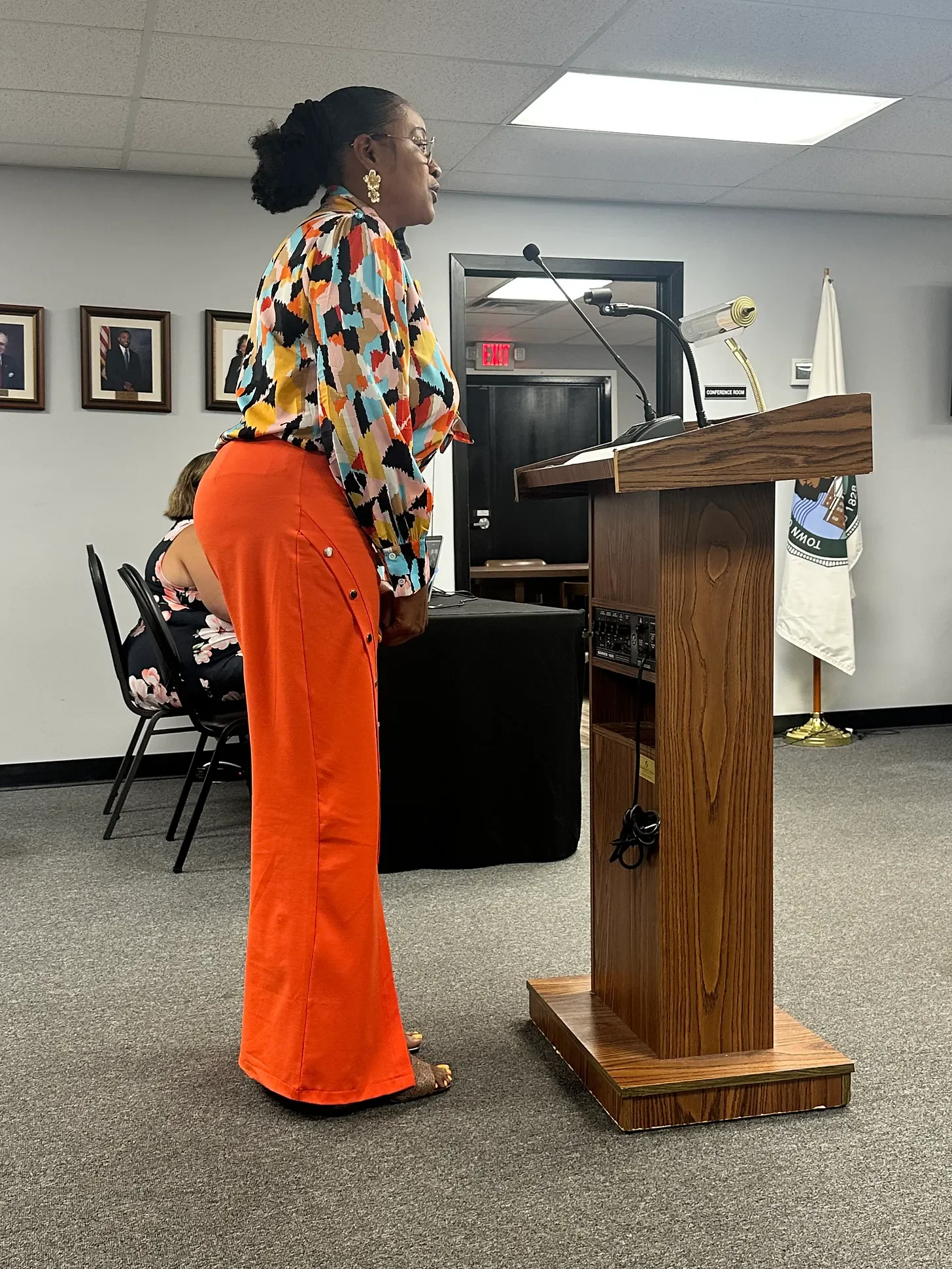
With the consent agenda cleared, the board opened the floor for public comments. Laura Exum used her three minutes to walk the board through a detailed, block-by-block account of what she called a longstanding traffic and pedestrian safety problem. She began by orienting the board to the town's downtown street grid: First Street runs beside the courthouse, Second Street is the main downtown corridor and connects to the town's bypass, and Third and Fourth Streets are both residential.
Exum focused on the point where traffic turning left off North Greene Street merges onto Third Street. "It's very narrow," she said. "It's a two-way, but it's hard for two cars to be in that location at the same time." She said visibility there is only adequate, and that once past the narrow merge point, Third Street "widens out into a nice wide residential boulevard," which she said encourages drivers to pick up speed. She described a pattern of drivers using North Greene Street to cut across to Third Street and accelerating as the road opens up, calling it "an ongoing problem for lots of years."
Exum said she experiences the danger firsthand nearly every weekday morning, driving Fourth Street to reach the senior center around 8 a.m. "The visibility right there at that merger is very poor, and it's not just the bushes; it's the way the streets come together," she said. She described having to come to a complete stop and inch into the intersection just to see oncoming traffic. "There's a need to stop completely on Fourth, creep out into the intersection so that you can look left last to make sure people aren't clipping on down there," she said, adding that children cutting through on their way to school add to her concern. She recommended the town install a stop sign at both merge points, noting Fourth Street already has one at its intersection, saying it "would slow the Third Street traffic down enough" to improve visibility for everyone using the intersection.
She also raised an issue with larger vehicles using the residential streets as a shortcut. "I've seen occasionally, I've seen transfer trucks on Third Street," she said, adding that she had been told the routing might be related to how the street is classified on GPS mapping services. As Pridgen signaled her three minutes were up, Exum moved quickly to a final point about pedestrian safety on Fourth Street, apologizing for running out of time: "I didn't pick up the pace." Vinson later clarified for the board that most of the streets Exum described are state Department of Transportation roads, with the exception of the stretch of Third Street beyond its merge with Fourth Street, which belongs to the town.
Davis Presses the Board on Billing, Then Withdraws Her Objection
Laquita Davis, who first raised the billing dispute at the August meeting, was the next to speak. She said her research, conducted independently through the same two organizations the town consulted, the School of Government and the League of Municipalities, had led her to believe the town could not retroactively bill for utilities, and that the board's own May meeting minutes described the rate change as taking effect "with the fiscal year." She argued that Snow Hill's fiscal year runs July 1 through June 30, a 12-month period, and that billing customers under the new rate a month earlier, in June, effectively added an extra month onto that fiscal year at ratepayers' expense. She said she did not understand how the town's presentation, which had cited a roughly $30,000 shortfall tied to a July 1 effective date, squared with what was actually billed.
Davis pointed out what she also believed was a lack of response from the town. "I was expecting to hear something from someone over the past four weeks, and many of you have my cell phone number," she said. "It has not changed from when I worked here." She pushed back on how her earlier comments had been characterized, saying she had come before the board "as a citizen that lives in the town and uses the water," not as a former town employee, and that she "didn't appreciate" the fact that it was raised that way. Davis then pivoted to her broader background, saying that "as a person who has worked in municipal government for 30 years," she believed "the order of things was not correct" in how her concerns were handled, and that in trying to get information from the town manager and the town clerk, she encountered a lack of communication that she said could have resolved the issue back in July. "I felt dismissed, overlooked," she said.
Davis closed her remarks by saying that if the board's decision was to begin billing under the new rate a month before the start of the new fiscal year, she would not pursue the matter further as a citizen. "I'll just let y'all keep my $12, I guess," she said.
Pridgen told the board he does not typically respond to public comments but wanted to address what Davis had raised. He said the town, the School of Government, and the League of Municipalities had spent "an extensive amount of time" researching the issue and agreed it fell into what he called "a gray area," since it touched on a relatively obscure area of municipal law, and that the town's advisors had been diligent in reporting back with answers at the very next meeting.
He said he believed Davis's reading of the board's action was a misinterpretation. As he understood the board's intent, reflected in the meeting minutes, the vote meant that collections at the new rate would begin with the new fiscal year, not that the new rates themselves took effect on the day of the vote. "I just want to make sure that was cool," he said.
Town Honored for Wellhead Protection Plan
Following public comments, Katie Dunning of the North Carolina Rural Water Association presented the Town of Snow Hill with an award recognizing the town's completion of an updated Wellhead Protection Plan, a document municipalities typically update every five years to help safeguard drinking water sources. Dunning told the board that Snow Hill was the first town she worked with when she joined the association in November of 2017, calling the presentation a full-circle moment. Vinson thanked Dunning for her work on the plan and on related town projects. Public Works Director Travis Warters accepted the award on behalf of the town.
Police Grant and Infrastructure Resolutions Approved
The board then turned to its action items, starting with a project budget ordinance for a $40,000 police department grant, an item Vinson had first previewed to the board at the August meeting when she estimated the town's local match at roughly $5,823.
With final figures in hand Monday, Vinson said the grant will fund in-car camera systems, a laptop computer, and a new radio, and that rising equipment costs since the grant was awarded had pushed the total project cost to $45,822.20, leaving the town to cover approximately $5,8223 from fund balance. Commissioner Lorraine Washington noted the town was nearing $6,000 in fund balance spending on the item; Vinson responded that the expenditure was buying the town $40,000 worth of equipment. The board approved the ordinance.
Commissioners next approved a resolution authorizing the town to apply for a state grant covering water system improvements. Vinson described the application as a "wish list" that includes rehabilitating Well No. 5, which has been out of service for three years, rehabilitating Well No. 2, replacing a generator, replacing an aging galvanized water line on West Harper Street, installing additional shutoff valves to allow the town to isolate leaks without cutting off entire blocks, and converting the town's chlorine system from gas to liquid chlorine. Vinson said the conversion could eliminate the need for roughly $95,000 in gas detection sensors that would otherwise be required at each well house. She said the town's recent capital improvement planning and asset management work should strengthen its competitiveness for the grant, though she cautioned that cost estimates and the mix of grant funding, principal forgiveness, and any required match or loan are still being developed with the town's engineering firm. A commissioner asked for a rough dollar figure for the grant, and Vinson said firm cost estimates were still being worked out with the engineering firm.
A companion resolution for wastewater system improvements was also approved, covering lift station upgrades, valve and generator replacements, electrical control panel upgrades at aging lift stations, and replacement of a deteriorating sewer main on Pine Street. Vinson said the town hopes to use remaining grant funds to complete additional work at the wastewater treatment plant left uncovered by an earlier $4.2 million project, noting the town previously decided to keep and, where possible, scrap decommissioned equipment from that project itself rather than let the contractor dispose of it, to recover some of the cost.
Sidewalk Contract Awarded to J&A Concrete
Vinson had tabled the town's sidewalk repair contract at the August meeting after learning the state Department of Transportation might handle curb and gutter work on Second Street, Third Street, and Greene Street, and after new bids arrived that needed review. On Monday, she reported that the NCDOT had agreed to take on that work, freeing the town to focus its contractors on other streets: Northwest Fourth Street, Northwest Third Street, part of Southeast Second Street, West Harper Street, and West Greene Street.
Vinson presented three bids covering sidewalk, curb, and gutter repairs in those areas. Trejo Construction bid $36,796.50, though Vinson said she did not know why the company's curb and gutter pricing ran higher than the other bidders. J&A Concrete, the contractor that has handled the town's sidewalk repairs for the past two years, bid $26,100. Tinoco Construction offered a turnkey bid of $20,975, covering sidewalk, curb, gutter, and driveway apron work.
Before discussing the individual bids, Mayor Andrews asked what would happen if the board approved one of the contracts, asking about warranty coverage. Vinson said each contract would carry a warranty depending on the provider chosen, and that the town would also attach its standard terms and conditions to whichever contract was approved, giving the town legal recourse if problems arose.
Commissioners then spent several minutes discussing each contractor's track record before voting. One commissioner asked directly whether the town had experienced any problems with J&A Concrete's past work. Vinson said she had no complaints about anything J&A had done for the town previously. Commissioners acknowledged that J&A's bid was not the lowest of the three, but said that mattered less than the company's reliability. "At least we know his work," she said, adding that even though J&A was "a little higher," the town knew him to be dependable.
Commissioner Deborah Harper then asked whether the town had prior dealings with the other two bidders. Vinson said Tinoco Construction is run by Salvador Tinoco and that the town had never worked with either his company or Trejo Construction. She described both as larger outfits that hold numerous state Department of Transportation contracts, noting that Tinoco's company was the same one that recently installed handicap-accessible ramps at town intersections. With no history working with either firm, the board voted to award the contract to J&A Concrete, citing the company's dependability and saying it "did a good job" on the town's past sidewalk repairs.
A separate item on 2017 Ford Explorer repairs, moved earlier in the meeting at the attorney's request, was set to be taken up after the board's closed session.
Monthly Department Reports
Police Chief Josh Smith reported five incident reports for the month, all of which were cleared, along with about 25 town ordinance violations, 22 state citations, and 10 traffic crashes. The department conducted joint active-assailant response training with the Greene County Sheriff's Office at the new high school, running officers through the exercise in two sessions so each shift could take part without pulling anyone off patrol. The department continues daily welfare checks at Snow Hill Primary and West Greene schools, as well as its Cop Companions outreach program. Smith said the department has increased speed enforcement on Third Street in response to resident complaints and has issued citations there. However, he noted lighter traffic volume on that street makes enforcement timing important. He also said planning is underway for the town's Trunk or Treat event, with most vendors from the previous year already confirmed.
Presenting the financial report in Williams' absence, Vinson walked the board through the town's checking and cash management accounts for the general fund, water and sewer fund, and power fund. She said revenue is beginning to pick up as the fiscal year progresses, though ad valorem tax collections are not expected to increase significantly until closer to payment deadlines. On capital projects, she said roof repairs at Well No. 4 are complete, with the contractor finishing exterior work, while progress at the wastewater treatment plant remains slow as contractors work through demolition and wait to order replacement equipment. She said the town's water and sewer improvement projects tied to a prior American Iron and Aluminum requirement, along with the lead service line replacement project, are complete but not yet formally closed out on the town's books, leaving Well No. 4 and the wastewater treatment plant as the town's two remaining active infrastructure projects.
Public Works Director Travis Warters reported six water leaks in August, four repaired in-house and two referred to an outside contractor, Edwin Hardy, because they involved larger water lines and needed same-day repair. He said the chlorine room at Well No. 1 has been completed, and the Well No. 4 rehabilitation project is nearly finished, with a small amount of remaining plumbing work. He said the town's sidewalk trailer used for curb and gutter work is no longer functional, and that street and curb work has also been delayed following the loss of the inmate labor crew the department previously relied on for grass cutting and other manual labor.
Parks and Recreation Director Toni Waters reported $580 in revenue from 290 visitors in August, a decline she attributed to the start of the school year. A free-admission "Sunday Funday" event drew seven children and $4 in concession sales. Waters said she is planning fall programming, including a possible movie night in October, a pumpkin carving event pending donations from local farmers, and a live or beach music event geared toward adults, aimed at keeping interest in the park through the fall.
Board Comments and Closed Session
Mayor Andrews thanked town staff for their work. She asked Chief Smith for clarification on one item in the police report, and Smith said, without going into detail in public session, that the case involved a person on an ankle monitor who was reported by a probation officer for being in a restricted location.
Commissioner Lorraine Washington raised concerns about a synthetic substance sold at local smoke shops, saying it has caused problems for some residents, including a case involving a former community board member's son. She said Greene County commissioners had already passed a resolution addressing the substance and indicated she would bring similar information and a proposed resolution to a future meeting. Pridgen told the board the matter had already gone to the state legislature for regulation and that the town likely lacks authority to regulate the substance's sale locally, but said the board could adopt a resolution opposing its distribution.
The board then voted to move into closed session to discuss legal advice, along with matters related to the potential location or expansion of businesses in the area and the acquisition of real property, as outlined on the meeting agenda. The 2017 Ford Explorer repair item was expected to be addressed following the closed session.