
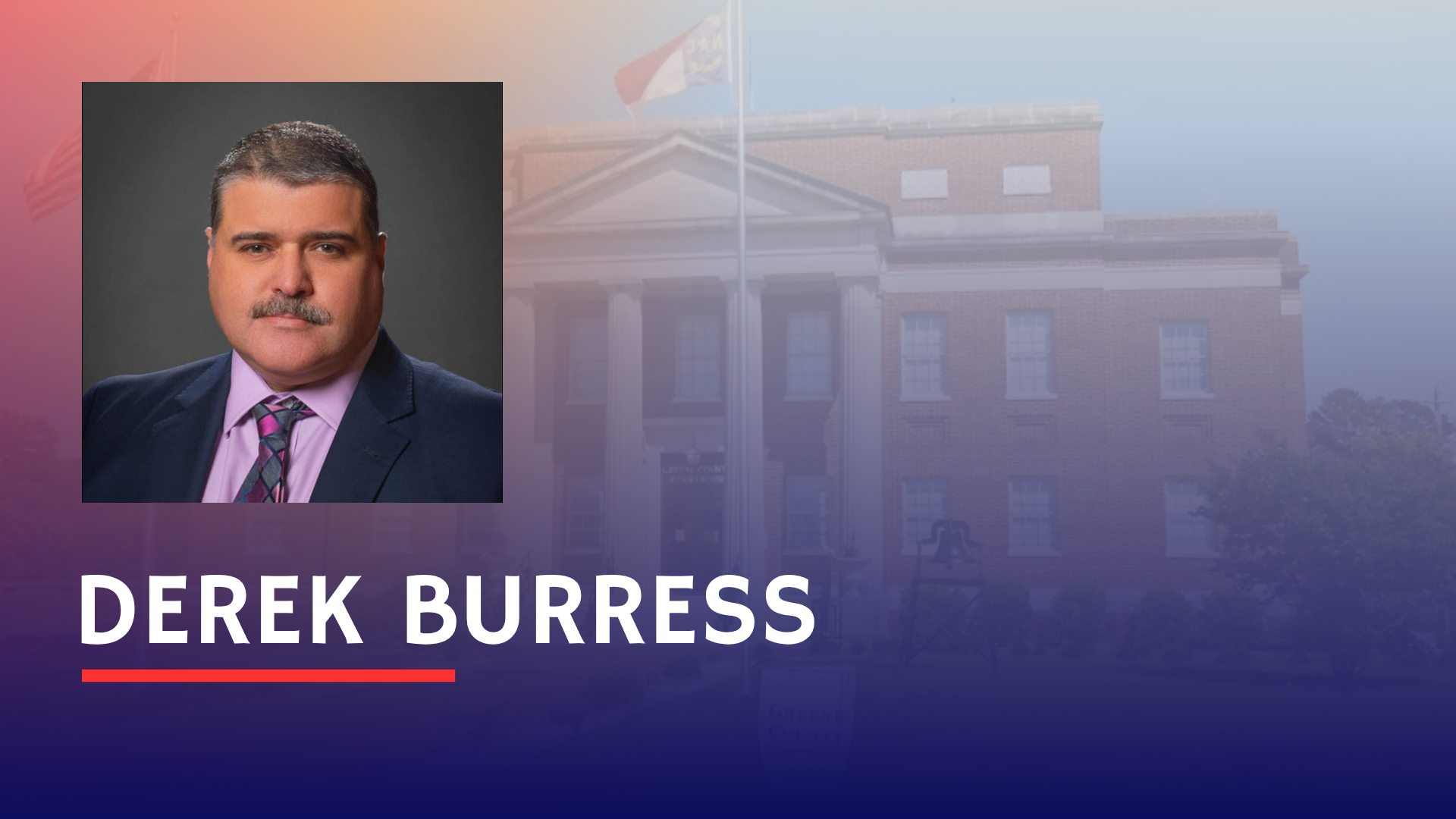
Greene County Commissioners Approve ECC Withdrawal and Opioid Settlement Participation; Oppose Property Tax Reform Measure
A 3-2 commissioner vote opens a window into a constitutional question that could reach North Carolina voters this November.
The Greene County Board of Commissioners met in regular session on Monday, April 20, 2026, at 5:00 PM at the Greene County Operations Center in Snow Hill. The agenda covered a full range of county business, including recognition of local volunteers, a detailed presentation on the beginnings of a new Comprehensive Land Use Plan, participation in an opioid settlement, reappointments to the Planning Board, a resolution opposing proposed property tax reform at the state level, and withdrawal from the Eastern Carolina Council.
Consent Agenda
The board unanimously approved the consent agenda, which included approval of the minutes from the March 2, 2026, and April 6, 2026 regular meetings, as well as routine releases and refunds of vehicle taxes. No budget amendments were included.
Monthly Tax Collection Report
Tax Administrator Stephanie Wiggins prepared the monthly all-levy collection report as of March 31, 2026, as required by N.C.G.S. 105-350(7). Collections continued to perform well overall. Year-to-date collections across all levy years reached $11,667,277.61, leaving $519,938.89 uncollected.
The current 2025 levy had $11,566,410.28 collected year-to-date against $373,335.92 remaining, for a 96.86% collection rate. Earlier years showed even stronger results: the 2024 levy collected $76,594.19 (99.60%), the 2023 levy collected $9,204.67 (99.76%), and the 2022 levy collected $4,416.97 (99.81%). Levy years 2015 through 2021 posted collection rates ranging from 99.85% to 99.95%.
Current month collections totaled $200,708.07. Supplemental levy activity included $11,935,847.81 added to the books, with $11,568,434.91 in principal payments received and $32,123.02 in interest. Year-to-date, the county processed $35,203.73 in releases, $6,979.10 in adjustments, $36,243.26 in refunds, and $2,095.61 in write-offs. The report was presented for informational purposes only.
Monthly Financial Report
Finance Officer Sandy Shirtz prepared the March 2026 monthly financial report. Through three quarters of the fiscal year, Greene County’s finances were tracking closely with budget expectations across major funds.
In the General Fund, revenues stood at approximately $19,534,176 (72.09% of the $27,098,153 budget), while expenditures totaled $19,632,807 (72.45% of the budget). Ad valorem taxes, the county’s largest revenue source, were performing strongly at 97.64% collected. Departmental spending varied: the Jail had reached 93.64% of its budget, Emergency Medical Services was at 90.44%, the Sheriff’s Office at 75.19%, and the School system had received $2,782,743 of its $4,069,942 appropriation (68.37%). Public Health and Cooperative Extension were running lower at 58.39% and 54.52%, respectively.
The Utility Fund showed revenues at 77.16% of, with expenses at only 50.07%, keeping revenues well ahead of spending. The Landfill Fund remained nearly balanced, with both revenues and expenses near 94.6–94.75% of the budget. The Transportation Fund reported revenues at 58.57% and expenses at 65.54%, consistent with typical grant timing lags.
County fund balances continued their positive trend, reaching $21,424,302. The Stabilization by State Statute reserve (the primary rainy-day fund) stood at $10,807,414, and the Opioid Settlement reserve had grown to $474,569. The financial report was for informational purposes only and required no board action.
Board of Equalization and Review
The board recessed to convene as the Board of Equalization and Review. Tax Administrator Stephanie Wiggins administered the Oath of Office. Since no formal requests for real property valuation appeals had been received as of April 14, 2026, the board recessed the 2026 session until Monday, May 4, 2026, at 10:00 a.m., before reconvening as the Board of Commissioners.
2026 Governor’s Volunteer Service Awards
Sharon Harrison, Greene County Senior Center director and local coordinator for the Governor’s Volunteer Service Award Program, recognized this year’s recipients. The awards honor individuals and groups for outstanding unpaid service to the community.
The honorees were:
Samantha Gay, who earned the prestigious Governor’s Medallion Award (one of only about 20–25 selected statewide) for her work founding and operating Fishers of Kids Anglers Academy, a nonprofit offering free fishing education, outdoor experiences, and life-skills mentoring to at-risk youth across eastern North Carolina.
Virginia Thomas, for her dedicated volunteer efforts at the Senior Center, including Meals on Wheels deliveries, teaching evidence-based health programs, Senior Games support, and Black History Month planning.
Chester and Dorothy Harrison, a retired Navy Captain and his wife, were recognized for long-term Meals on Wheels service, Senior Center activities, church involvement, and outreach to local veterans.
Greene Central FFA, honored as a group for hundreds of hours of volunteer service at the Greene County Animal Shelter, where students cleaned pens, washed animals, and provided companionship.
New Greene County Comprehensive Land Use Plan – Insight
Ashli Barefoot with the planning firm Insight provided a thorough kickoff presentation for Greene County’s updated Comprehensive Land Use Plan. The existing plan dates back to 2012, and state law under N.C.G.S. Chapter 160D requires a current plan to enforce zoning regulations and issue consistency statements for zoning map or text amendments.
The new plan is intended as a long-term (approximately 25-year) strategic document that will deliver policies, programs, and projects to guide land use decisions, infrastructure investments, and service delivery. It aims to strengthen the county’s agricultural economy and existing businesses while charting a clear direction for future growth.
Barefoot outlined a six-phase process:
Project Kickoff (already underway), including staff meetings, project management planning, and development of a community engagement plan.
Baseline Review & Data Collection, pulling together existing plans, GIS data, key locations, approved developments, and utility information.
Community Engagement, featuring public meetings, an online survey, a project website, press releases, and social media outreach.
Existing Conditions and Opportunities Analysis, covering community character, housing, the local economy, growth patterns, environmental considerations, equitable services, and infrastructure needs.
Future Land Use Framework, which will explore growth scenarios, preservation strategies, transportation corridors, and identify growth nodes.
Plan and Implementation Strategy, establishing goals, policies, strategies, objectives, and a prioritized action plan organized by investment level (low/medium/high), anticipated timing, and responsible entities, while identifying potential funding sources.
She stressed the importance of broad participation and called for help from the Planning Board, county staff, the Board of Commissioners, and a wide range of stakeholders—including business owners, farmers, forestry interests, tourism operators, emergency services, nonprofits, developers, educators, church leaders, and others.
Chairman Bennie Heath noted the scale of the undertaking, commenting that “you got a big task.” The presentation was for informational purposes only, and no board action was taken.
Remnant Defendant Opioid Settlement Agreement and Planning Board Appointments
The board unanimously approved a resolution authorizing Greene County’s participation in the Remnant Defendant Opioid Settlement Agreement. This allows the county to receive and allocate any resulting funds for approved opioid remediation efforts, with the Chairman authorized to execute all necessary documents.
The board also unanimously reappointed three Planning Board members—John Grant, Henry Lanier, and Leslie Mooring—to new terms. The reappointments ensure continuity, particularly as the board will review the developing Comprehensive Land Use Plan.
NCACC Update on Property Tax Reform
County Manager Kyle DeHaven provided an update on ongoing property tax reform discussions at the state level. The board then approved (3-2) a resolution from the North Carolina Association of County Commissioners (NCACC) formally opposing a proposed constitutional amendment advancing in the General Assembly.
The proposal, which had cleared the House Select Committee on Property Tax Reduction and Reform on April 15, 2026, would direct the legislature to establish a framework limiting the annual growth of local property tax levies—potentially tied to inflation and population growth—with provisions that could require voter approval for exceeding those limits. Counties would retain the ability to set their own tax rates and conduct assessments, but significant revenue increases beyond the cap could trigger a referendum.
Chairman Bennie Heath and Commissioner Robert Taylor, Jr. spoke in favor of the opposing resolution, stressing the value of local control. Heath pointed to Greene County’s upcoming 2029 revaluation, noting that flexibility would be needed to adjust the tax rate appropriately afterward, especially if assessed values rise sharply as they have in surrounding counties. Taylor was direct: “I am not for the state setting my tax rate. I think every county should have its own say.”
Commissioner Derek Burress voted against the resolution and offered a detailed explanation. He began by commending the board for holding the tax rate steady for the past five years, which he has been on the board, calling it genuine fiscal discipline. However, he noted that many residents have still seen significant increases in their tax bills due to rising property assessments. Burress referenced data showing property taxes rising 50–60% in many counties since 2020 (while inflation was around 30%), and cited polling from the Carolina Journal indicating that nearly 77% of North Carolinians view property taxes as a burden and 73% would support a constitutional amendment to limit local increases.
He argued that the proposal would not eliminate local authority but would shift certain decisions on extraordinary levy growth from elected officials to the voters themselves. Burress stated that passing the opposing resolution now—before the full details of the amendment are finalized—would place Greene County on record against a reform supported by a strong majority of residents and could limit the county’s ability to help shape responsible limits that work for rural areas. He expressed a preference for staying engaged in the conversation rather than stepping away from it.
The resolution opposing the amendment passed by a 3-2 vote, with Commissioners Burress and Johnson in opposition. This was the only divided vote on action items during the meeting.
Resolution of Withdrawal from ECC Membership
The board unanimously approved a resolution to withdraw Greene County from membership in the Eastern Carolina Council (Neuse River Council of Governments, commonly known as the ECC).
The move followed a candid March 30, 2026, memorandum from ECC President Edward Riggs Jr. that outlined a serious financial crisis. The memo attributed the problems to poor management and questionable practices by former staff, which had depleted available funds. Liquidity stood at only about $7,000 through the end of the fiscal year—well below the $150,000 minimum needed for operations and far short of a healthy $500,000 reserve. Without additional member contributions, the organization faced potential cash flow shortfalls starting July 1, 2026, and dissolution remained a possibility. The memo also noted unpaid obligations, including the IRS.
County Manager Kyle DeHaven explained that Greene County had learned to operate largely without many ECC services over the past decade, with the exception of the Area Agency on Aging role (which the county plans to address separately due to its federal funding structure). He expressed confidence that transportation planning and regional economic development efforts, particularly those centered in Kinston, could continue successfully through existing partnerships.
Commissioner Derek Burress addressed the withdrawal, acknowledging the work of individual ECC staff members he had collaborated with over the years. “I’ve gotten to know many of the staff personally over the years. I think the world of David, I think the world of Angela and Colby, and I think they do good work,” he said. However, he added that looking at the current situation, he did not see a viable path forward for the organization as it stands. “I hate it, and I don’t think anyone on this board wants to lose the services the Agency on Aging provides, but I just do not see a way forward in the current situation.”
The resolution authorized County Manager DeHaven to prepare and deliver the required 60-day notice of withdrawal to other member governments.
Commissioner Comments
Chairman Heath opened commissioner comments by praising the staff and volunteers who had made Ram Fest a success on April 18th. He credited Recreation Director Malcom Daweson and the broader county team for pulling together a well-attended event despite 92-degree heat and some persistent insects, offering one lighthearted note about a young child who had been disappointed to find the bouncy house relocated to the ball field.
Heath then turned to a more earnest appeal, encouraging everyone present to attend the Special Olympics event for the county’s exceptional students, set for Friday, April 24, at 10:00 a.m. at the high school. He said he had recently learned that 15% of Greene County’s students are exceptional students, a figure that had caught him off guard. “There is absolutely no reason why we should not support our children at this event,” he said. “EC kids are important to us also.”
Commissioner Burress also took a minute to thank the staff and volunteers who had worked Ram Fest before and congratulated Sheriff Matt Sasser on being named reserve grand champion at the 2025 Sheriff’s Showdown during the Coastal Plains Junior Livestock Show and Sale in Kinston, a recognition he felt the board should acknowledge publicly.
Burress then raised an unresolved thread from the April 6 meeting. At that meeting, the board had voted to accept a $70,000 monetary bequest left by a private individual to the Greene County Animal Shelter, with County Manager DeHaven recommending the funds be placed into a capital reserve for use toward a new animal shelter facility. Following the April 6th vote, County Attorney Kevin MacQueen had noted that Edward Jones of Ayden, the financial institution handling the donor’s estate, would need a formally confirmed county representative authorized to accept the bequest, and had asked the board to confirm that authority extended to him. Burress said at the April 20th meeting that he did not recall a formal motion being made granting that authority and that it did not appear in the minutes.
MacQueen responded that he had since been in contact with the financial institution, that they had provided him with specific instructions on what was required, that the steps were straightforward, and that he expected to have the matter resolved promptly.
Closed Session
The board then entered closed session pursuant to N.C.G.S. § 143-318.11(a)(3) for attorney-client privilege. No action was taken upon returning to open session before adjourning.
Greene County’s Vote Reflects a Larger Debate Over Property Taxes in North Carolina
On Monday night, April 20, 2026, the Greene County Board of Commissioners voted 3-2 to approve a resolution formally opposing a proposed constitutional amendment under active consideration in the North Carolina General Assembly. The proposal, which cleared a key House committee on April 15, 2026, could eventually require the legislature to limit how much local governments may increase property tax revenue from one year to the next without direct voter approval. As of April 27, 2026, the amendment had not yet come before either full chamber.
Commissioners Derek Burress and Ray Johnson voted against the resolution, meaning they did not formally support opposing the changes being considered. Johnson did not speak publicly before the vote. Burress offered detailed comments framing his position as a policy disagreement rather than a partisan one.
The discussion was not heated. Instead, it reflected a genuinely complex question facing communities across North Carolina: how to balance local government control over taxation with growing concerns about property owners’ affordability, particularly those on fixed incomes, as assessed values climb.
How Property Taxes Work in North Carolina
Property taxes in North Carolina are administered locally. Each county sets a tax rate, expressed in dollars per one hundred dollars of assessed property value. A homeowner’s annual tax bill is that rate multiplied by their property’s assessed value.
County commissioners set the rate. The county tax office determines assessed values through a process called revaluation, which state law requires at least every eight years, though some counties choose shorter intervals. Greene County’s last revaluation took effect January 1, 2021, with the next scheduled for 2029, according to the North Carolina Department of Revenue.
The distinction between the tax rate and the tax bill matters more than many homeowners realize. When property values rise through revaluation, a homeowner’s annual bill increases even if the county never changes its published rate. After each revaluation, counties must calculate and publicly disclose a revenue-neutral tax rate, which is the rate that would produce the same total revenue as the prior year at the new assessed values. Counties are not required to adopt it. Local boards set rates through a public budgeting process that includes public hearings. Current state law places no cap on how much total property tax revenue a county can collect from one year to the next.
Greene County’s Rate History
Greene County’s property tax rate is $0.786 per $100 of assessed value. That rate has remained unchanged since it was set following the 2013 revaluation and has stayed the same through the 2021 revaluation and every fiscal year from 2021-22 through 2025-26, according to the North Carolina Department of Revenue county property tax rate tables.
In 2021, Greene County was navigating the challenges of the COVID-19 pandemic, including heightened demands on emergency medical services and public health responsibilities. The county was also in the process of upgrading its EMS coverage to the paramedic level, a change it implemented in February 2022.
The Board of Commissioners chose not to lower the tax rate to the revenue-neutral level after the 2021 revaluation. This decision helped address elevated service needs according to county budget reports. As a result, some homeowners whose assessed values rose after 2021 have seen higher tax bills without any change to the published rate.
What This Means for Greene County Homeowners
The county’s current tax rate is $0.786 per $100 of assessed value. Greene County’s next scheduled revaluation is 2029. If assessed values rise as they have in surrounding counties, tax bills could increase even if commissioners never change the rate.
A levy limit, if enacted, would require commissioners to lower the rate enough to stay within an allowable revenue cap, or take the question to voters. No specific limit has been set in the proposed amendment. All details would be determined by the General Assembly through separate legislation, and only after voters first approve the constitutional framework.
The following scenarios use Greene County’s current rate of $0.786 per $100. They are simplified illustrations, not forecasts or official projections. Actual outcomes would depend on the formula the General Assembly adopts, local decisions, parcel variation, and applicable exemptions.
A home assessed at $150,000 today carries an annual county tax bill of $1,179. If the 2029 revaluation finds that the home is worth $225,000, a 50 percent increase consistent with recent revaluation cycles in several North Carolina counties, the bill rises to $1,768.50 at an unchanged rate. That is an increase of roughly $49 per month with no change to the published rate and no direct vote. Under a hypothetical levy limit allowing roughly 15 percent total revenue growth over four years, the county might lower its rate to approximately $0.54 per $100, and that same homeowner, now assessed at $225,000, would pay approximately $1,215, an increase of about $36 annually rather than $589.
A levy limit would not freeze revenue permanently. If Greene County’s population grew 10 percent over four years and inflation averaged 3 percent annually, a limit tied to those factors might allow total property tax revenue to grow by roughly 22 to 25 percent over that period. Most proposed frameworks include provisions for exceeding the cap through a voter referendum. The specific formula ultimately adopted by the legislature would determine how these dynamics play out for any individual county.
Voices From the Board
Chairman Bennie Heath focused on long-term planning. With the 2029 revaluation approaching, he argued that commissioners will need flexibility to respond when assessed values change, and that property tax authority is the county’s most important financial tool. "In 2029, we will have a revaluation. If the revaluation goes as surrounding counties have gone, that is when it is going to be time to really pay attention to what is going on and make adjustments to our tax rate," Health said.
Commissioner Bobby Taylor argued for local control, telling the board, “I’m not for the state setting my tax rate. I think every county should have its own say.”
County manager Kyle DeHaven also supported the resolution. "The problem with any type of change in authorities is, when does it stop? It may just be this much this year, but it could turn into more. This kind of takes away the local authority that you all have for your main source of revenue to fund the services that we provide,” Dehaven said. “It just handcuffs you,” Heath said in response. “I believe 70 or 71 counties have done revaluations in the past four or five years. All have reduced their rate," Dehaven added.
Commissioner Derek Burress, who voted against the resolution, argued that rising property values increase what homeowners pay even when the published rate never changes. For residents whose incomes do not keep pace with reassessed values, such as retirees, disabled homeowners, and longtime owners, the real burden is the final tax bill, not the rate in the budget ordinance.
Burress also argued the board was taking a formal position before the amendment’s final details had been written. He said Greene County should stay engaged in the legislative process and advocate for protections suited to rural counties, rather than oppose the proposal outright. In his view, a well-designed levy limit would not eliminate local authority but would require governments to justify large increases directly to voters, with exceptions available for genuine emergencies. “Greene County is not the problem. But Greene County’s constituents live in the same state as the counties that are. They deserve the same protection.” He closed on the question of timing and influence. “This is Greene County stepping out of the conversation at the exact moment our voice matters most. I would rather stay at the table and shape what responsible levy limits looks like for rural counties like ours than signal opposition now and have no say at the table when it really counts.”
Commissioner Ray Johnson joined Burress in voting no but did not speak publicly, so his specific reasoning was not stated on the record.
Commissioners on both sides of the vote acknowledged the same underlying conditions: the county must maintain essential services, residents are sensitive to rising tax burdens, and the 2029 revaluation could create fiscal pressure. The disagreement was over how to respond, whether to defend existing local discretion or to engage with a statewide framework that may advance regardless of Greene County’s position.
What Lawmakers Are Proposing
The House Select Committee on Property Tax Reduction and Reform, formed by House Speaker Destin Hall, voted on April 15, 2026, to advance a proposed constitutional amendment toward a full floor vote. To reach voters, it must pass both the House and Senate by a three-fifths supermajority. If it clears both chambers, the question would appear on the statewide ballot on November 3, 2026.
The amendment text would direct the General Assembly to enact laws limiting the amount by which the levy on property may increase, which may include exceptions. The amendment itself does not set a specific limit, formula, or exceptions framework. Those details would be determined through separate legislation passed after voters approved the constitutional requirement.
Speaker Hall said after the April 15 committee vote that limits would likely be tied to inflation and population growth, and would likely allow local voters to approve exceptions. Those specifics reflect the sponsors’ stated intentions but are not written into the amendment as filed.
“Families are getting ripped off as some local governments rake in billions more than inflation and population growth warrant.” – House Speaker Destin Hall, April 15, 2026
Rep. Brian Echevarria of Cabarrus County, who introduced the proposal, told the committee that property taxes have typically risen 50 to 60 percent since 2020, while inflation rose about 30 percent. “What this amendment does is, at the will of the voters, require the General Assembly to establish limits on the growth rate of property tax levies, ensuring any future increases are deliberate, transparent, and constrained within a defined policy framework that protects homeowners, renters, and business owners,” Echevarria said.
Rep. Jeff Zenger of Forsyth County described a constituent conversation with a woman in her seventies whose property tax bill had more than doubled in five years. “Our governments don’t want to cut their spending,” Zenger said. “But guess what? This lady will have to. Does she go to Meals on Wheels? Stop taking medicine? She’s on a fixed income.”
Rep. Julia Howard of Davie County, co-chairwoman of the committee, said voters had strong views on the issue. “People are very concerned about their property tax, but they’re gonna speak loud and clear. When they do, then it’s gonna be your responsibility to address the issue, and it’s not an easy fix.”
A Nearby Example: Kinston and Lenoir County
In 2025, Lenoir County completed a revaluation that produced sharp increases in assessed values. Glenwood Olds, a senior and disabled resident who has owned his Kinston home for 30 years, saw his assessed value rise from approximately $25,373 to $103,801. His annual tax bill increased from $409.77 to $1,458.41.
The City of Kinston approved a rate of $0.73 per $100 of assessed value for fiscal year 2025-26, down from $0.77 the prior year but still above the city’s calculated revenue-neutral rate of approximately $0.60. City Manager Rhonda Barwick stated that the revaluation produced about a 35 percent increase in Kinston’s property tax base, generating additional revenue directed toward employee wages, new positions, and infrastructure.
Supporters of the proposed amendment point to cases like Kinston as the kind of outcome that should require direct voter approval. Local government officials counter that Kinston faces ongoing cost pressures, including aging water and sewer infrastructure, state-mandated services without full state funding, and public safety staffing demands. They note that constraining the tax levy could shift those pressures to fee increases, service reductions, or deferred maintenance.
How Other Counties and Organizations Have Responded
Local governments across North Carolina have moved quickly to respond to the proposal. Wake County Board Chair Don Mial called property taxes “our most stable revenue source,” noting they fund approximately 75 percent of Wake County’s annual budget.
Mecklenburg County Board Chair Mark Jerrell warned that a blanket statewide cap is “a one-size-fits-all approach” that does not account for how different counties operate. Pitt County commissioners unanimously passed a resolution opposing the amendment. Wayne County commissioners passed the resolution 5-1.
The NC League of Municipalities warned that levy limits could trigger lower bond ratings and raise borrowing costs for local governments. That concern carries added weight following the widespread infrastructure damage caused by Hurricane Helene across western North Carolina in 2024.
Rep. Eric Ager of Buncombe County argued at the April 15 committee hearing that rising property taxes reflect decisions made at the state level more than local overspending. “We’ve really left local governments holding the bag. Most are doing their best to ensure that they’ve got good fire departments, good law enforcement agencies, good schools, and they’re not getting the support that traditionally they have gotten from the state government.”
Rep. Maria Cervania of Wake County said the proposal does not adequately address rising property appraisals as a driver of higher bills, separate from any deliberate rate increase.
A procedural issue noted by some observers is that North Carolina does not allow special elections for voter referendums. Any local override question would need to appear on a primary or general election ballot, which could create timing conflicts with county budget adoption deadlines.
Before the April 15 committee vote, the NC Association of County Commissioners proposed more targeted alternatives, including expanding eligibility for existing property tax deferral and homestead exemption programs designed to help older, disabled, and lower-income homeowners.
The resolution passed by Greene County commissioners stated that the board formally opposes any constitutional amendment that would restrict, cap, or otherwise limit county property tax authority.
What Has Happened in Other States
Some form of property tax levy limit is already in place in 28 states, including Texas and Washington. Outcomes vary widely depending on the design of the limit, available exceptions, and local cost conditions.
Massachusetts enacted Proposition 2 1/2 in 1980, limiting annual levy growth to 2.5 percent plus new growth from construction. Communities can seek overrides through voter approval. The cap has helped keep overall property tax levels relatively controlled. However, some communities have faced challenges in funding services during tight budget years when costs rose faster than the cap allowed, leading to staff reductions, library or senior center closures, wage freezes, or deferred maintenance in cases where overrides were not approved.
In Ohio, legislation passed in 2024 and 2025 has included measures to cap or limit growth in property tax revenue for local governments and school districts. Local officials, including the Ohio Municipal League and associations representing firefighters, have warned of potential budget shortfalls, service reductions, layoffs, and deferred maintenance. School districts have expressed concerns about impacts on teacher positions and funding stability.
The situations in Massachusetts and Ohio do not translate directly to North Carolina, as state fiscal structures and local conditions differ. Both examples illustrate why the specific design of any levy limit determines its practical effect.
What Voters Would Decide
If the amendment clears both chambers with the required three-fifths supermajority and reaches the November 3, 2026, ballot, voters would be asked whether to add language to the North Carolina Constitution directing the legislature to enact laws limiting annual increases in local property tax levies. A yes vote would add that constitutional directive. It would not set any specific cap, approve any formula, or immediately change any county’s rate or revenue authority. A no vote would leave the constitution unchanged. The amendment remains pending before the full House and Senate.
Supporters of the amendment argue that voters should have the opportunity to decide whether this framework should exist at all, with the specific rules to be worked out through legislation afterward. Opponents argue that asking voters to approve a constitutional change before the details are written asks them to authorize something without knowing what it will require.
A Statewide Question With Local Stakes
Greene County has held its property tax rate at $0.786 per $100 of assessed value through every fiscal year from 2021-22 through 2025-26. The county’s 2029 revaluation, if it produces increases similar to those seen in neighboring counties, could substantially change assessed values for longtime homeowners. Under the current system, that would raise tax bills without any change to the published rate. Under a levy limit, it would require commissioners either to lower the rate significantly or to take an exception to voters.
The Greene County Board of Commissioners’ 3-2 vote illustrates how this debate is already taking shape at the local level. Commissioners who voted differently acknowledged many of the same pressures. Whether those pressures are better managed through local discretion or through a state constitutional framework requiring voter approval of large increases is a question the state may be asked to weigh in on before the end of 2026.