

Where was Richard Caswell in 1781?
“Sink or swim, live or die, survive or perish. I am for independence now and forever.”
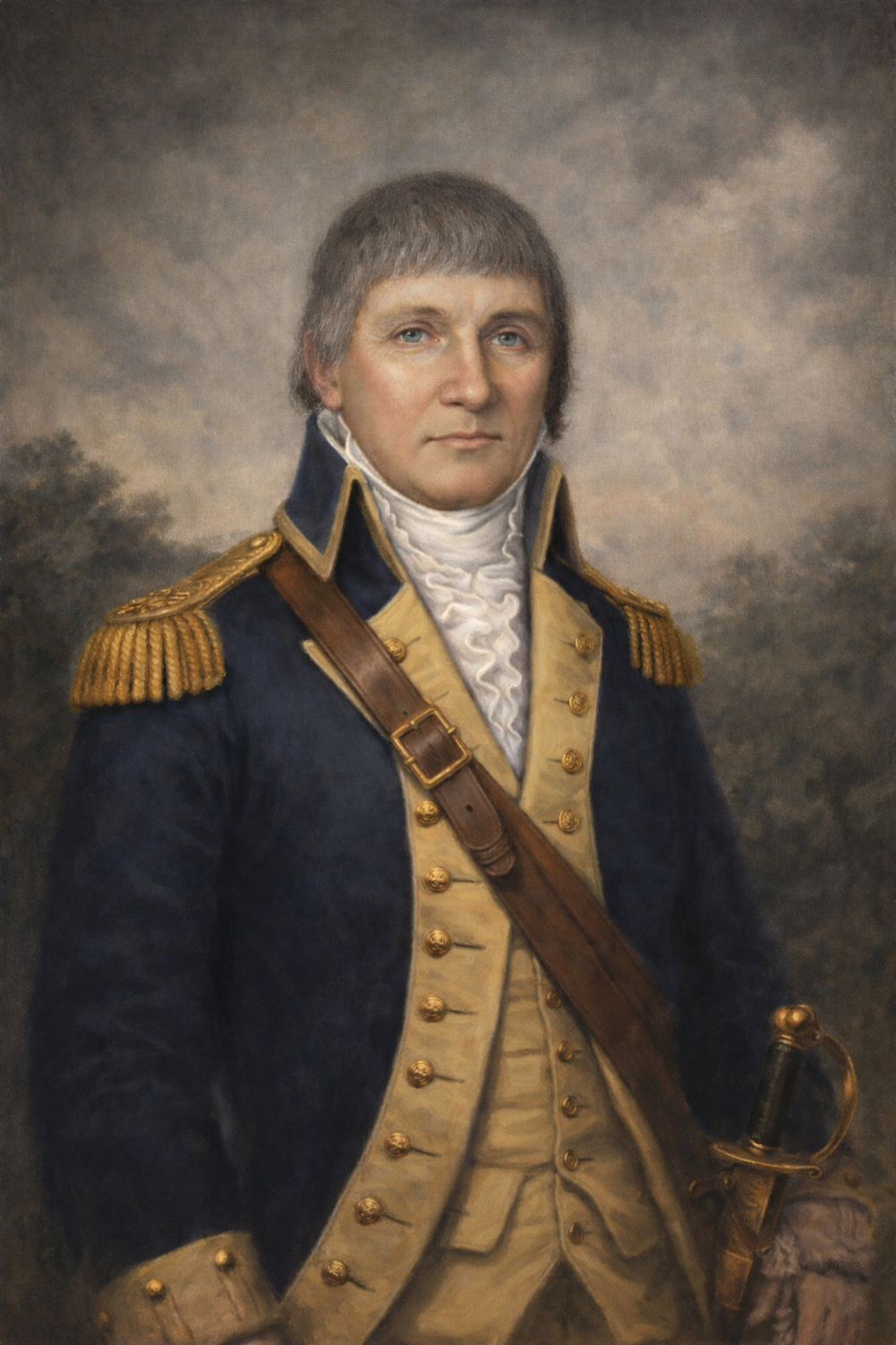
Where was Richard Caswell in 1781?
By Stacey Jones
The rationale for writing this article is to provide details on the whereabouts of Maj. Gen. Richard Caswell during 1781. It seems that there are few historians, due to the lack of source material, that attempt to state at any length his location and activities engaged in, so he appears to be somewhat elusive during that period. The desire to determine the truth originated when trying to study the skirmishes of 1st and 2nd Kingston that occurred in August of 1781, which some historians state that Richard Caswell led the patriot militiamen against Maj. James H. Craig’s British and Loyalist forces.
In a deeper dive of 1st and 2nd Kingston, a full-scale study developed covering from the time Craig seized and occupied Wilmington, North Carolina in January 1781 until the time he abandoned his garrison at that place in November of that year. This was accomplished to reconstruct Craig’s raid into the eastern interior of the state that occurred primarily in August 1781. What was discovered while researching primary resources, which mainly included North Carolina Colonial and State Records and Revolutionary War Pensions, was that Richard Caswell was not revealed in them as a participant, but his son Brig. Gen. William Caswell was prevalent within the sources as commanding officer of the New Bern Military District, along with Brig. Gen. John Alexander Lillington of the Wilmington Military District. They were the major leaders that dealt with Craig’s occupation in 1781, and exclusively in August during Craig’s raid.
The research showed that William Caswell and Lillington were communicating directly to Governor Thomas Burke regarding the movement and actions of the British with no correspondences or mentions of Richard Caswell, the commanding officer of the entire North Carolina Militia. Some historians have erroneously confused letters or mentions of William Caswell to be letters or mentions of Richard Caswell and therefore have tangled a knot in the historical narrative about who, when, and where, especially when discussing Craig’s raid. The primary resources clearly point out the fact that Richard Caswell was not in eastern North Carolina dealing with the British and Loyalist there, and 1st and 2nd Kingston did not happen! Read August Reign of Terror: Major James H. Craig’s 1781 Punitive Raid by Stacey Jones with Dennis Harper to understand the true historical events that took place in August 1781.
So, where was Maj. Gen. Richard Caswell in 1781? First, let’s understand what occurred in the previous year of 1780. Richard Caswell had been appointed major general of the North Carolina Militia in the spring. Later that summer, on August 16, at the Battle of Camden, commander of the Continental Southern Army, Maj. Gen. Horatio Gates, along with Maj. Gen. Richard Caswell were defeated by Lt. Gen. Charles Cornwallis’s British forces. Soon following Richard Caswell became sick and absent. Unknowingly, the North Carolina General Assembly replaced him as commander of the militia in September with Maj. Gen. William Smallwood. Upon receiving knowledge of his replacement, he resigned his position as major general that October. The militia officers of the state were dissatisfied with the Assembly’s decision to replace Richard Caswell with the Marylander, Smallwood, to lead them. Gates had been replaced by Maj. Gen. Nathaniel Greene after his defeat and show of cowardness during the Battle of Camden. After Greene realized the disdain that occurred from Smallwood being appointed to replace Richard Caswell, he sent Smallwood back to Maryland where he would be of greater assistance in recruiting troops. By early February 1781, the Assembly made amends with Richard Caswell and reappointed him as major general in command of the North Carolina Militia once more.
Now, returning to the original question, “Where was Maj. Gen. Richard Caswell in 1781?” In attempting to answer this question through researching primary sources, a few letters can be referenced to help begin the trail. Duke University houses a collection of Richard Caswell correspondences in which one provided his whereabouts in January 1781, Halifax, North Carolina. Another collection of his letters was printed in the April 11, 1845 edition of the Weekly Raleigh Register newspaper that was offered by James W. Bryan for publication. These letters corroborate that he had been in Halifax in January and revealed his whereabouts in February 1781. Richard Caswell arrives in Kingston from Halifax on or before February 9 and begins writing to different people chiefly Col. James Kenan, Capt. Fredrick Hargett, and Governor Abner Nash between that date and February 17 regarding current troop counts, equipment and supply inventories, and the recruitment of more troops for service.
North Carolina Colonial and State Records offered another clue to where he was in early 1781. In a letter dated April 15, 1781, he writes Governor Nash from “Dobbs,” discussing correspondence between military leaders and Cornwallis movements. It is important to state at this point that while Richard Caswell was recruiting troops in the eastern part of the state he himself was not directly involved in the Battle of Guilford Court House the previous month on March 15. The action was decided as a win for Cornwallis against Greene’s patriots, but the victory came at a great cost to the British and Cornwallis moved his army east toward Wilmington, North Carolina to be resupplied by Craig’s garrison. The April 15 letter would be the last from Richard Caswell that exists for primary research, so his trail grew cold. How could there be no surviving correspondences to or from this major player of North Carolina during this important time in the State’s history and the American Revolutionary War?
During further research, another clue arose. A biographical article of Richard Caswell in the July 19, 1834 edition of The Harbinger newspaper from Chapel Hill, North Carolina that was taken from the Raleigh Register shed some light on where he may have been after April 15, 1781.
Early in 1781, it was discovered that the British army, under their distinguished leader, Lord Cornwallis, intended to evade and ravage North Carolina; and under such circumstances, Caswell deemed it all important to secure the public papers and records, by removing them to the western part of the State. He left behind him his two sons, General William and Col. Richard Caswell, exhorting them to oppose and harass the enemy.
According to the excerpt from the article, it is understood that he went to the western part of North Carolina with the State’s documents for safekeeping. After Cornwallis left the west to come east, arriving in April, Richard Caswell left the east to go west, maybe leaving mid to late April. This action would presumably be done secretly and require limited correspondences so not to divulge his location, which would help explain the lack of primary sources existing today. And, although his efforts had been statewide to recruit troops while he was in the east, now he would possibly double down on those efforts in the west.
Now the understanding can develop to why William Caswell and John Alexander Lillington were communicating directly to the new governor, Thomas Burke, who was often in Hillsborough or Williamsborough, North Carolina, regarding the affairs of the British commanded by Craig during the late spring and summer months of 1781. The reason for the generals in the east to be communicating with Burke instead of their direct command was most likely due to Richard Caswell being secretly disposed of in other duties during that time. If Richard Caswell went to the farthest military district in North Carolina, he would have been in the territory of the Salisbury Military District, the largest military district in the state.
As the details of his possible whereabouts started to be developed, another clue is discovered that corroborates the 1834 article in The Harbinger that further stated that Richard Caswell returned from the western part of the state in late 1781. The source is Revolutionary War pensioner, Samuel Evans, who stated that his unit joined up with the 1,200 foot soldiers commanded by Caswell in the vicinity of Wilmington just before the attempt to overrun Craig’s garrison and take the town back from the British in November 1781. The pensioner is somewhat mistaken about the leadership of the troops. Brigadier General Griffith Rutherford commanded the 1,200 foot soldiers that were primarily from the Salisbury Military District. However, he may have had knowledge that Maj. Gen. Richard Caswell may or may not have been present and held overall command. This may have been when Richard Caswell returned to the east in the fall of 1781.
It is plausible that the reason that the westernmost military district traveled across the state to the easternmost military district to confront the enemy was performed so at the command of Maj. Gen. Richard Caswell, commander of the entire North Carolina Militia, and not at the sole desire, discretion, or authority of Rutherford. It is important to note that Richard Caswell may have chosen that district for a couple of different reasons. The Salisbury Military District was the farthest west and the largest which could provide protection and safety of the State’s records, and as an opportunity to raise a large militia secretly to return east with to challenge Craig.
The research provided is possibly the most accurate narrative to date. It is fair to offer that some historians state that illness prevented Richard Caswell from commanding on his own and needed help. Therefore, that was the reason he was not in the spotlight. Not finding primary evidence of any debilitating sickness in 1781 to support that explanation leads one to believe that this was a way to describe the lack of primary sources. The reality is that the Assembly replaced him in 1780 during a time of illness, so what prevented them from doing it again if in fact he was ill during one of the state’s most important periods of military need? And the fact that he remained in command of the state’s militia throughout the remainder of the war gives some evidence that the traditional reasoning for his elusiveness in 1781 is inaccurate.
The point is this, Richard Caswell was always an effective leader in many capacities in the state of North Carolina, and in essence an important figure in the founding of our country. The evidence provided serves as proof that he was an effective leader in 1781, protecting the assets of the state and helping to bring independence through his efforts of recruiting and commanding troops. Years later North Carolina Supreme Court Judge, William Gaston while visiting Boston, Massachusetts had a conversation with the ex-president, John Adams, in which Adams inquired about Richard Caswell’s family and he stated that “Caswell was a man. We always looked to Caswell for North Carolina.”