LCPS high schoolers get up close and personal with Reality of Money
When 60 students from LCPS high schools moved through a reality-based simulation designed to give them a taste of what it takes to make ends meet financially, Emma Cottrill and Lea Penny, both juniors at South Lenoir High School, recognized a hard truth simultaneously.
“Stuff is really expensive,” they said.
Such is the lesson of life on your own, of life as an adult, and one key lesson of Reality of Money, a financial literacy exercise conceived by the State Employees’ Credit Union (SECU) and put into motion Wednesday at the Lenoir County Livestock Arena with the help of N.C. Cooperative Extension in Lenoir County, Lenoir County 4-H and Career and Technical Education teachers from Kinston, North Lenoir and South Lenoir high schools.
Students began with a projected monthly income based on randomly assigned 25-year-old adult-life profiles that included such characteristics as education, occupation, marital status and credit score. Their challenge was to cover the costs of food, housing, transportation and other requirements of adult life without burning through their paycheck. Thirty-five adult volunteers stood by at “expense stations” to provide additional information on the essentials, from health insurance to entertainment.
In the end, though, the tough decisions that separate need from want were in the hands of the students.
“They will hopefully come out of this knowing there is a lot of decision-making that goes into your monthly budget,” said Laura Lang-Tribula of Kinston, senior vice president at State Employees’ Credit Union. “They will come out with the realization that furthering their education is important and making responsible financial choices is important. They should leave here with a better fiscal sense of what is possible.”
Emma’s fictional self has a job as a certified nursing assistant and is married without children. The couple pays $940 a month for rent. Her credit score is 625, a number rated as “fair.” About halfway through the exercise, she felt good about her prospects. “I have enough money,” she said.
Lea, her friend in real life, was less sanguine about the impact of her profile: barista without a high school diploma and married for four years to a man who, for whatever reason, isn’t pulling his own weight. “I have to pay for his stuff,” she said.
“For health insurance, I’m paying $375. For my home each month I’m paying almost $1,000. Basic wi-fi is $85 and a basic phone, which is not very much, is $135. Clothes for me and my husband is $140. And on top of that, my friend got married and I had to pay $30 for a wedding gift,” Lea said.
Along with the monthly costs of her profile life, Reality of Money led her to consider another deficit. “I wish I had finished high school. I wish I could have bettered myself,” Lea said. “I could have done more with my life.”
Such personal traits, even if invented, add a layer of specificity to the lessons taught in Economics and Personal Finance, a required class in which all 60 students are currently enrolled at their high schools.
“We have a whole unit on budgeting and money management, so this is a perfect example of what we’re teaching in the classroom – but with a hands-on aspect,” said Ashley Turnage, who teaches the course at South Lenoir. “We hope they’re going to know how to set up a budget and manage their money.”
Lenoir County 4-H, which joined Lenoir County Volunteer Master Gardeners in boosting the extension service’s presence, signed on as a lead partner with SECU because of the exercise’s practical approach and its connection to 4-H’s own financial literacy programs, according to Joel Dixon, extension program assistant with 4-H Youth Development, and Abbigail Wells, extension agent for 4-H.
“Our big mission in 4-H is to give kids the opportunity to learn with hands-n experiences,” Dixon said. “This is a great opportunity for them to learn. This curriculum is from State Employees’ Credit Union but it pairs so well with not only the school standards but our curriculum. It is literally one of the best partnerships we could go into.”
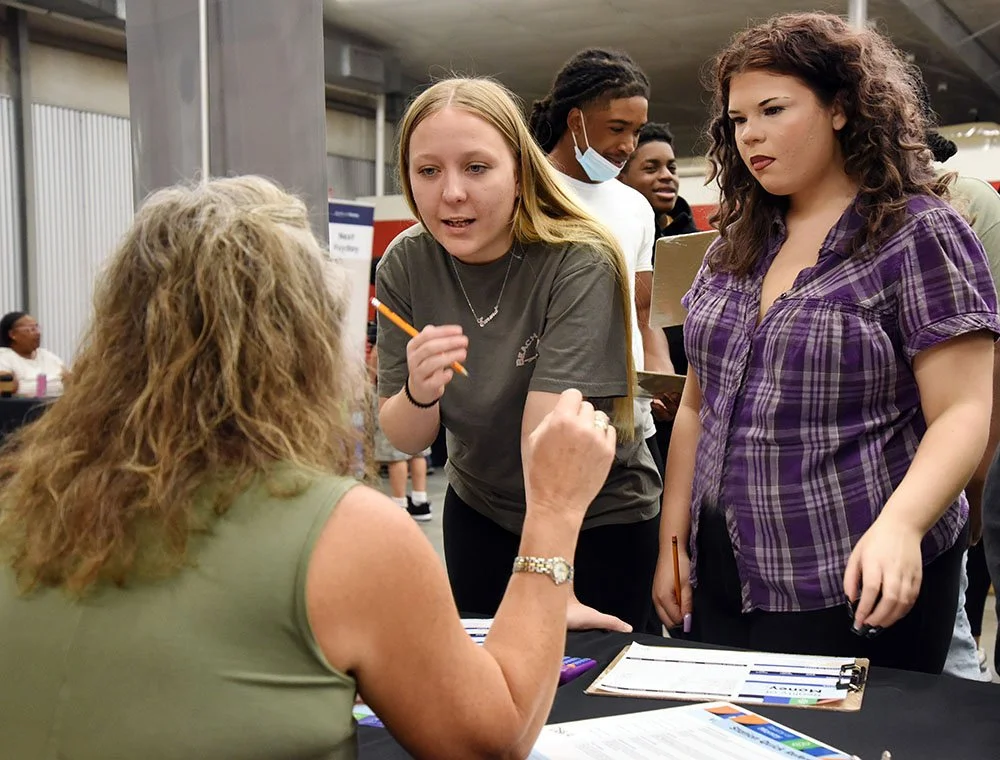
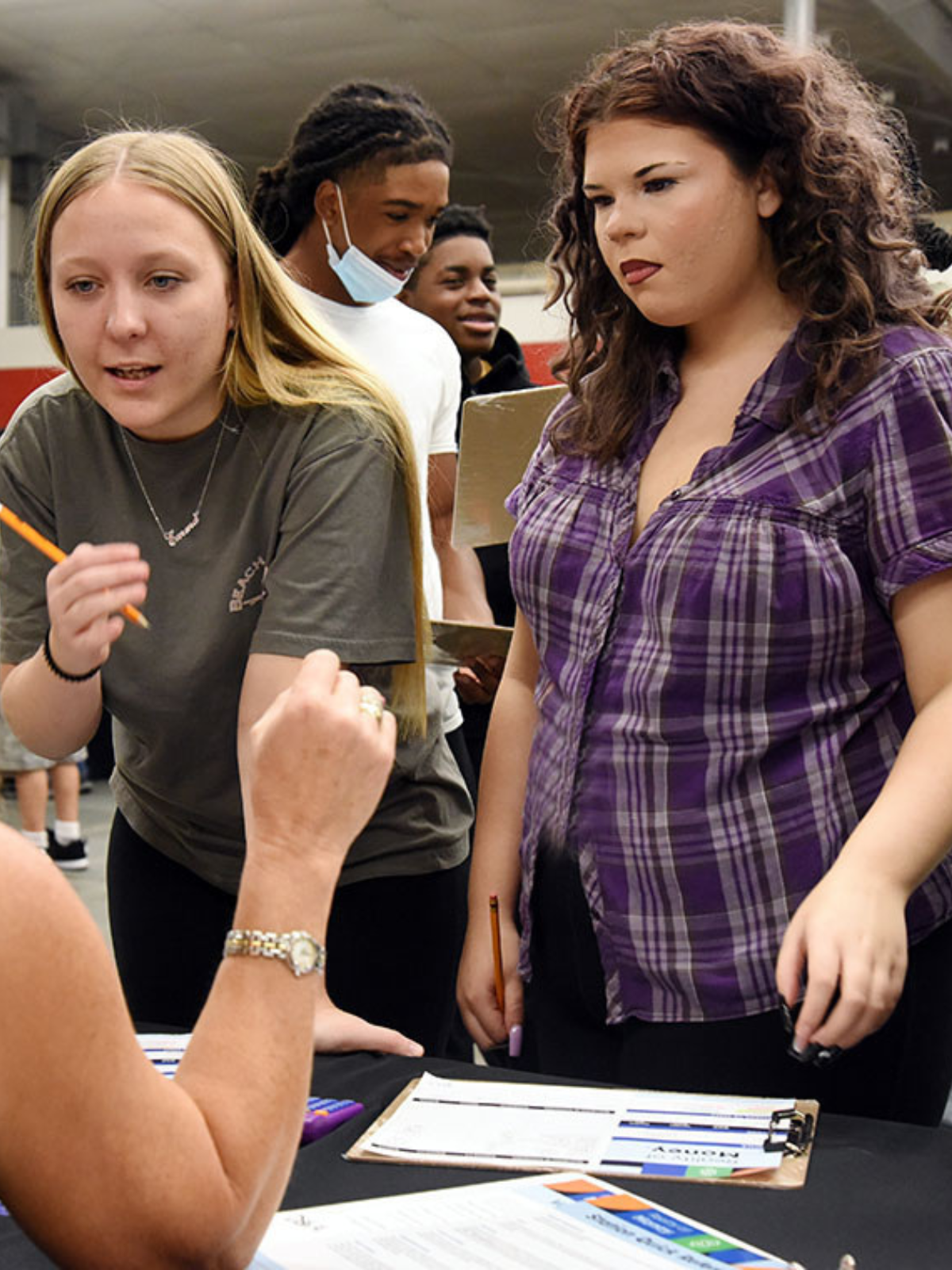
South Lenoir High School juniors Emma Cottrill, left, and Lea Penny budget food costs with the help of Velvet Tyndall, a Family and Consumer Science agent with N.C. Cooperative Extension, during Wednesday’s Reality of Money financial literacy exercise. Sixty students from LCPS high schools took part in the event, organized by the State Employees’ Credit Union, Lenoir County 4-H and N.C. Cooperative Extension in Lenoir County.