
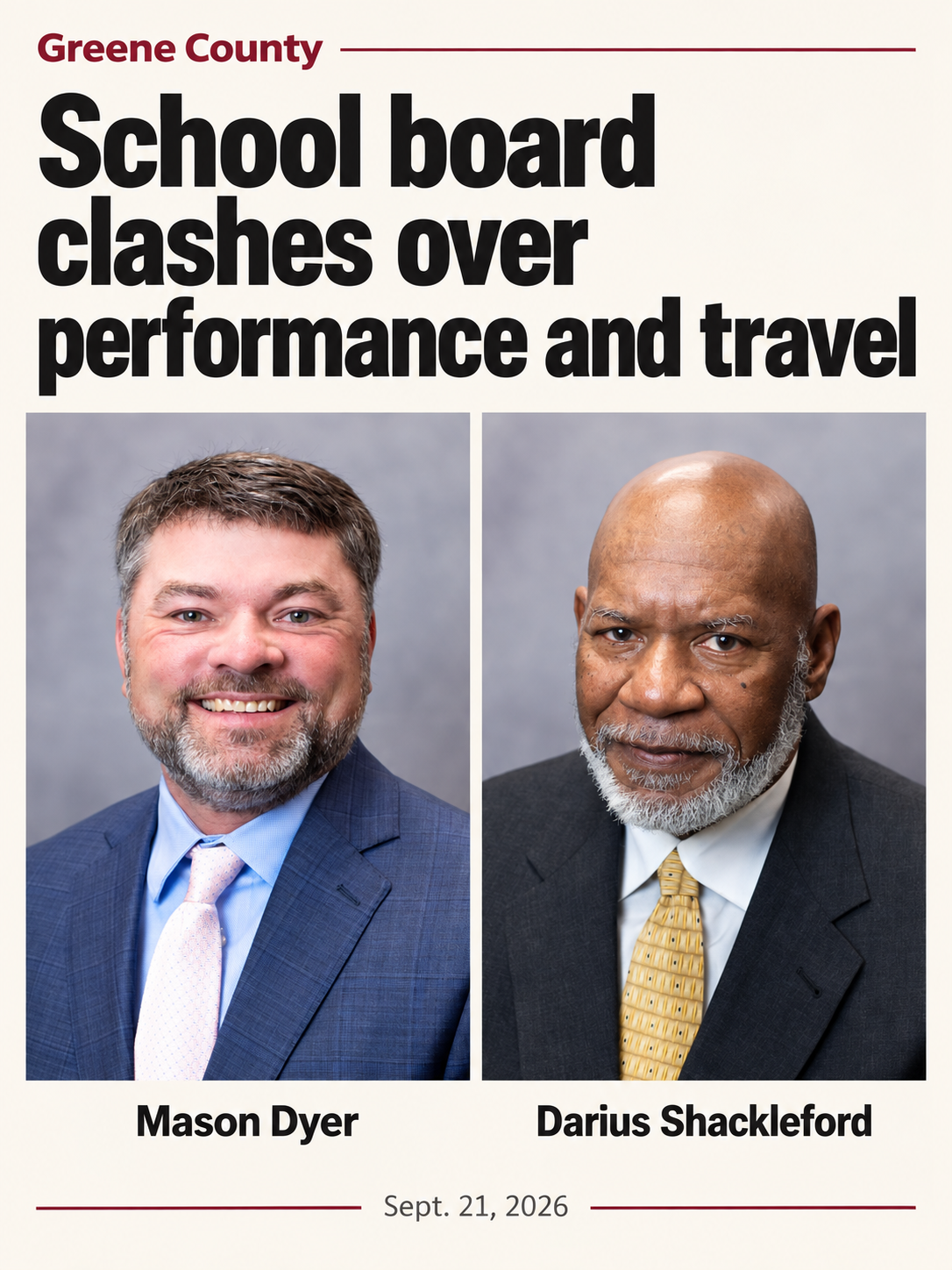
Greene school board clashes over performance and superintendent’s proposed training trip
Greene County school board members clashed Sept. 21 over student achievement, leadership accountability and whether Superintendent Rodney McNeill should travel to Argentina for training, with the discussion widening to concerns about race and election-year politics.
The disagreement began over removing McNeill’s travel request from the agenda and continued through an extended board comment period. Vice Chairman Mason Dyer pressed for changes to improve school performance, while board member Darius Shackleford defended the value of professional development and urged members to consider cultural differences affecting students.
“As a team, we are failing our students,” Dyer said. “As a team, we may not have the right people in the right positions.”
Board member Leisa Edwards Batts objected to the removal of the travel request and voted against approving the agenda. She said East Carolina University would cover the training costs, leaving no cost to the school system.
Batts said she believed the request should remain on the agenda so the board could consider it. Chairman Brandon Johnson acknowledged her dissent and said the agenda still passed.
Dyer said he had requested that the item be tabled for further discussion. Later in the exchange, he said the proposed trip was scheduled for March of the following year.
During his prepared remarks, Dyer described the district’s academic struggles as a shared responsibility and called for serious discussions about personnel, curriculum and other changes needed to improve student achievement.
“It is time to make difficult decisions, hold individuals accountable, and take decisive action when performance does not meet expectations,” he said.
Dyer said he did not have every answer but believed the district needed a comprehensive improvement plan. He urged leaders to assign responsibilities based on the school system’s needs and separate personal relationships from evaluations of professional performance.
“I respect and appreciate the people who serve this district, but personal relationships and professional performance must be evaluated separately,” he said.
He also connected his concerns to his family’s experience. Dyer said two of his children, now attending college, had graduated near the top of their high school class but did not feel fully prepared for the academic demands they encountered. He acknowledged the disruption caused by the COVID-19 pandemic while calling for stronger preparation for college, employment, military service and other paths.
Shackleford responded that the district’s problems predated McNeill’s administration and previous administrations. He said improving outcomes required new information and a better understanding of the cultural differences between students and educators.
Shackleford described the district’s student population as predominantly students of color and its teaching staff as predominantly white. He argued that the district needed to address the disconnect he saw between those groups.
He defended the potential benefit of McNeill’s training trip.
“If he can go to Argentina and learn something and it ain’t costing us nothing, it’s a great thing,” Shackleford said.
Dyer countered that his concern was the superintendent’s availability while the district worked through its problems.
“I’m not against him going,” Dyer said. “I’m against him not being here when we’ve got a problem at hand that we need to fix.”
As members began responding to one another, Johnson intervened and asked them to allow each speaker to finish. He said he wanted the discussion to remain open while ensuring members were recognized before speaking.
Shackleford later cautioned against the appearance that demands for change had intensified because McNeill is Black. He also warned that election-year politics could deepen divisions in the community and distract from students’ needs.
Dyer rejected the suggestion that race motivated his remarks and said his criticism addressed the district as a whole.
“There was no race involved,” Dyer said.
“All I’m saying is that we need to focus the time and energy and resources that we have to fix the problem,” he said.
Dyer said he supported continuing education but believed McNeill’s presence in the district was more valuable under the circumstances. He also said he had spent time listening and learning how the school system operated before making his concerns public.
Johnson said the board needed to be transparent, accountable and willing to ask difficult questions. He noted that members were expecting a presentation on school performance later in the meeting and encouraged them to question district leaders about the results and improvement efforts.
“I believe, as a board, it’s our responsibility to be accountable and be transparent,” Johnson said.
He said responsibility extended from board members through the superintendent, principals and school staff, and emphasized the need for members to work together despite their disagreements.