Venita Wright-Blake: Let’s celebrate!
“Let’s celebrate!” I often look forward to gathering together with others to celebrate lived experiences. Holidays, birthdays, anniversaries, and milestones are all reasons to rejoice. Parents have parties to celebrate children’s birthdays. Couples go out to dinner to celebrate wedding anniversaries. Families come together to applaud their high school and college graduates. Communities come together to celebrate holidays.
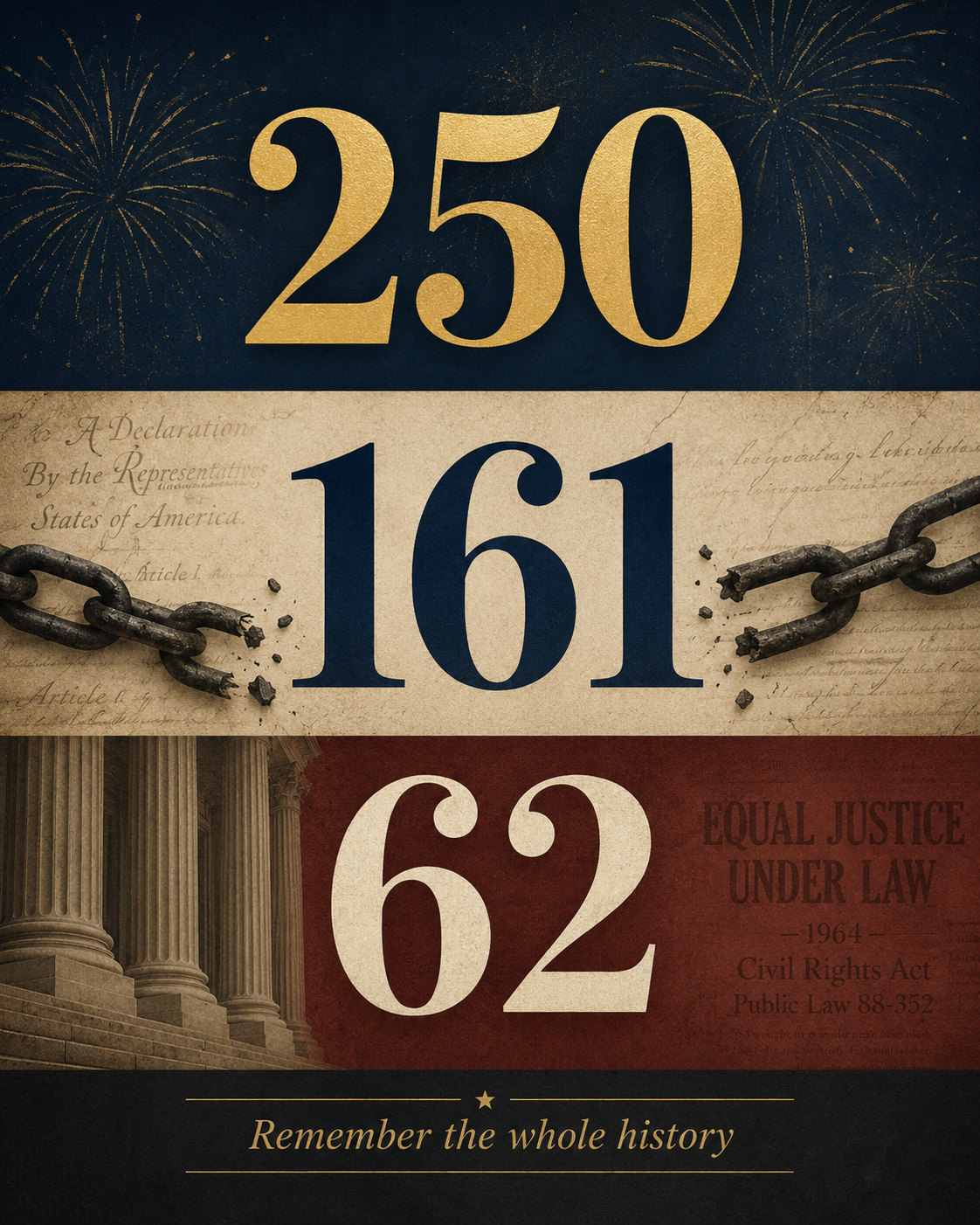
On July 4, 2026, America will celebrate 250 years of freedom from England. Specifically, America will remember the signing of the Declaration of Independence. America will remember the founding fathers and their efforts to establish a nation free from tyranny and injustice. America will remember July 4, 1776. There will be fireworks, parties, cookouts, beach trips – gatherings to celebrate and remember.
I will marvel at a fireworks display. I will enjoy food from the grill and a slice of cake. I will laugh with family and friends. I will also shed tears. I will cry and feel sad, as I have been for so many months leading up to this grand occasion. Why? Why should I feel sad when I think about the great day when the founding fathers established a new country, a new system of government, a republic of democracy? Why?
One hundred and sixty-one. That is a number that brings the sadness. One hundred and sixty-one. As America celebrates 250 years of freedom, I also recognize that it has been less than that - 161 years in fact - since slavery legally ended in this country. Black people were not free 250 years ago. Slavery ended in 1865 with the passage of the Thirteenth Amendment. But just because slavery legally ended – that doesn’t mean that it socially ended. Freeing slaves didn’t mean that Black people were automatically free to join the pursuit of happiness.
Sixty-two. That is the number that brings the tears. As America celebrates 250 years of freedom, I remember that it has only been 62 years since segregation legally ended in this country with the Civil Rights Act, signed in 1964. America may have been free for 250 years, but for Black people, it has only been 62. Similar to slavery, when segregation legally ended – that doesn’t mean it socially ended. Were Black people suddenly welcomed into establishments with open arms in 1964? Were schools, restaurants, churches, and businesses suddenly replacing White Only signs with All Are Welcome signs in 1964? Have Black people really been free for 62 years?
The numbers are sobering. The lived experiences are heartbreaking. The tragic history is being overshadowed by parties, fireworks displays, and slogans. We cannot remember 250 without remembering 161. We cannot remember 250 without remembering 62.
I am not writing this as a political message. My goal is to help us all remember the whole history. My hope is that we will understand that not everyone who thinks of 250 only thinks of the birth of a nation. Many of us think of the trials of our ancestors. Many of us have grandparents that are just a few generations removed from slavery. Many of us have parents that lived through segregation. For many of us, history is a lived experience. For some of us, history is still in our memory.
Should we celebrate America 250? Of course we should. Should we celebrate the birth of a nation? By all means. Should we rejoice for freedom? Absolutely. But, we also have to remember that it hasn’t been 250 years of freedom for everyone.