Crystal Hayden says rural health care should not mean lower expectations
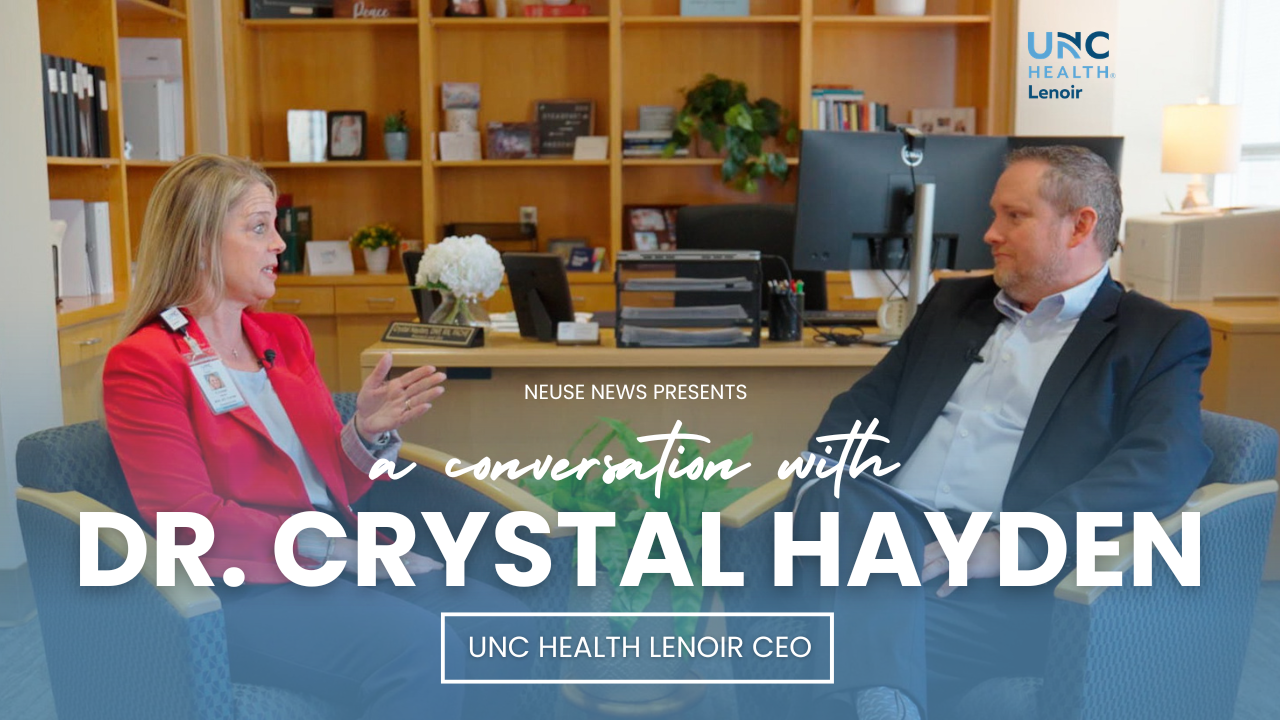
As she nears three years at the helm of UNC Health Lenoir, Dr. Crystal Hayden says her work is guided by a simple conviction: people in rural communities deserve the same standard of care patients expect anywhere else.
For Hayden, that means investing in technology, strengthening services, recruiting physicians and rebuilding trust with patients and families who depend on their local hospital. It also means refusing to accept the idea that geography should limit access.
“Our philosophy is that where you live should not determine whether you have access to that technology,” Hayden said.
That philosophy has shaped much of the hospital’s recent direction.
Hayden said UNC Health Lenoir benefits from local governance while also drawing on the resources of a larger health system. She said the hospital’s board is made up of local residents, allowing decisions to stay rooted in the community, while system support helps provide resources a rural hospital might not otherwise be able to secure on its own. One example, she said, is Epic, the hospital’s electronic health record system, which she described as a premier tool that can be cost prohibitive for many rural community hospitals.
For Hayden, access to that kind of infrastructure is part of a larger obligation.
She said tools such as the upgraded cath lab and the da Vinci surgical robot are no longer just signs of innovation. In many cases, they are becoming standard expectations in modern medicine. As physicians train on newer technologies and patients expect high-quality care close to home, Hayden said it becomes the hospital’s responsibility to meet that standard locally.
Her focus on measurable improvement extends beyond equipment.
Hayden pointed to the hospital’s Leapfrog A grade and top rural hospital recognition as signs of progress, but she framed both as reflections of staff performance rather than trophies. She said Leapfrog grades are based on publicly reported and hospital-submitted objective data, including process measures, outcomes and improvement over time. Hayden said the recognition was meaningful because it reflected the work employees are doing every day to improve care.
“It’s really a reflection of all of the great work that the team is doing here,” Hayden said. “Do we get it right every single time? No, we are not perfect, but we are pursuing excellence every single day.”
That pursuit of excellence is tied to a broader strategy Hayden said has guided the hospital in recent years.
She said the hospital’s strategic plan is built around four pillars: optimizing service lines, improving emergency department operations and throughput, enhancing quality in care and workforce development, and reestablishing trust and relationships with the community. Hayden said those priorities continue to drive decisions across the organization, from emergency department changes to physician recruitment and service expansion.
Recruitment, she said, has been especially important.
Hayden described a process that goes beyond simply interviewing a physician candidate. The hospital, she said, tries to recruit the whole person by introducing candidates to peers, leaders and the culture they would be joining, while also taking into account spouses, children and other family considerations. That approach has helped the hospital recruit providers in general surgery, orthopedics, pulmonology and gastroenterology, strengthening services that had been limited or fragile.
She also sees workforce development as a local responsibility.
Hayden said Lenoir Community College plays an important role in preparing workers who can step directly into hospital jobs. She highlighted a nursing scholarship program that covers tuition, books, fees and a monthly stipend in exchange for a work commitment at the hospital. She said that program is both an investment in the community and an investment in the future of health care in Kinston.
Looking even earlier in the pipeline, Hayden said health science programs for high school students help young people understand that hospitals offer many career paths beyond becoming a doctor or a nurse. Exposing students to those possibilities earlier, she said, can help build the next generation of local health care workers.
Hayden also spoke at length about culture inside the hospital, describing it as one of the most important parts of leadership.
She said she has been encouraged by a willingness among staff to embrace change, test new ideas and learn from setbacks. Rather than treating failure as something to avoid at all costs, Hayden said the organization tries to view it as part of the process of improvement.
“We call that failing forward,” Hayden said. “It’s okay to fail. People do it every single day. But what’s important is that you learn lessons from that and you use it to move yourself, your department, and your organization forward.”
She said leadership works to reinforce that mindset through gratitude, transparency and direct communication. Meetings often begin with appreciation, Hayden said, and leadership regularly meets with frontline staff to hear frustrations, identify pain points and better understand what employees need to do their jobs well.
For Hayden, that internal culture matters because it shapes the patient experience.
She said a strong hospital in rural Eastern North Carolina is essential not only because patients deserve quality care, but because travel itself can become a health burden. When patients have to go farther for care, she said, they may delay treatment, which can lead to more serious and expensive problems later. A strong local hospital, in her view, supports both community health and the broader health of the local economy.
That concern is especially visible in the emergency department, which Hayden described as the hospital’s front door. She said patients often arrive during some of the most stressful moments of their lives, and the goal is to make that experience as warm, efficient and reassuring as possible.
“We want them to be welcomed as a friend and as a family member,” Hayden said.
In the end, Hayden’s vision is not built around claiming perfection. It is built around growth, accountability and the belief that local patients should not have to leave home to receive strong care. Her comments reflect a leader focused less on celebrating a title and more on building a hospital that the community can trust.