New computer coding curriculum builds job skills, learning skills
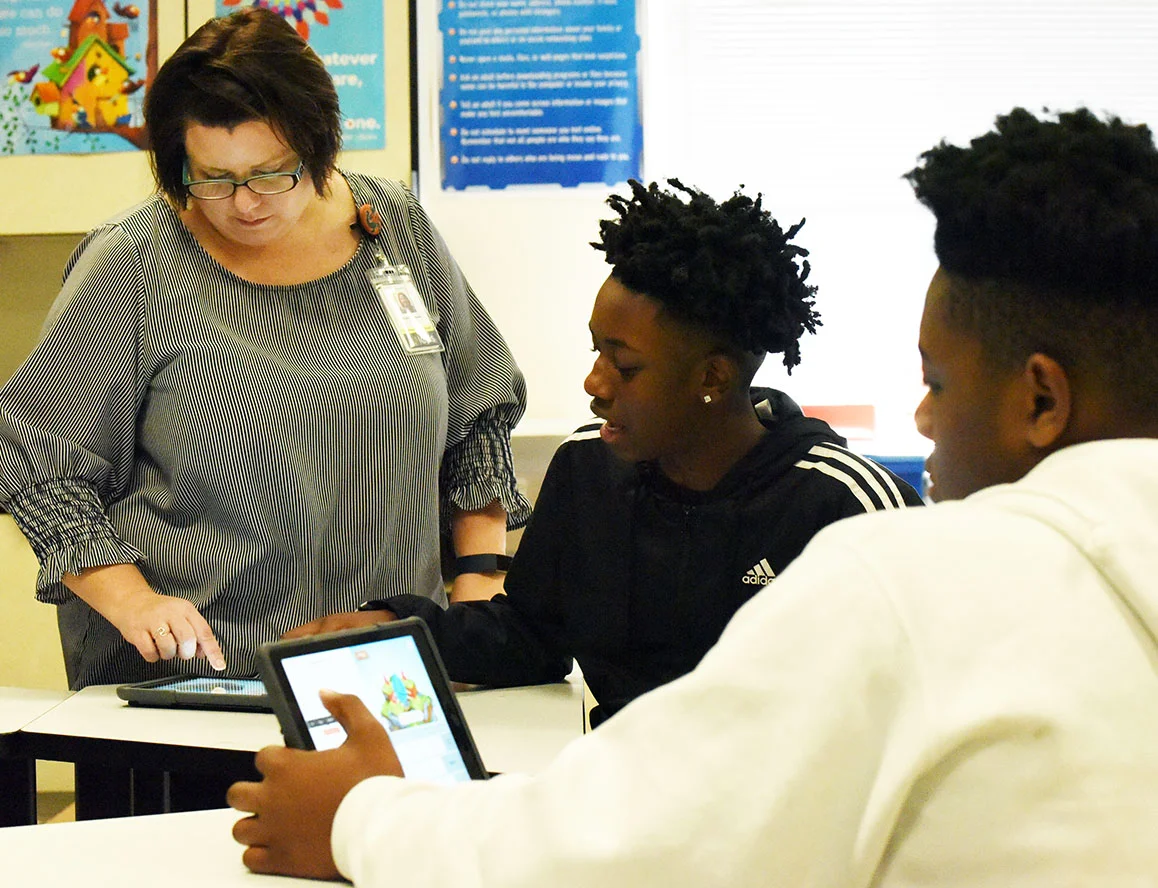
Stephanie Harrell, who helped designed and now teaches LCPS’s new computer coding curriculum, works with eighth grade students in the STEM Center at Contentnea-Savannah K-8 School. The district teaches basic coding to middle school students as part of the STEM program and offers more advanced coding classes as electives in high school. Photo by Patrick Holmes / LCPS
In the same reasoned, methodical way the instruction unfolds, Lenoir County Public Schools is building a new curriculum in computer coding that sharpens learning skills and puts students on the path to a lucrative career.
LCPS has parlayed a $36,160 state grant — one of the first 15 Coding and Mobile App Development Grants awarded in late 2017 – into an instructional program that is reaching virtually every middle school student in the district and provides more advanced classes for high school students. When fully realized, the program will make coding part of the school day at every grade level, beginning in kindergarten.
Conceived as an offering of the district’s CTE (Career and Technical Education) program, the coding curriculum introduces students to skills much in demand in the 21st century job market. But the educators behind it also recognize that, even for those not drawn to computer science, the discipline required to write code can cultivate students’ capacity for logical thinking, perseverance and teamwork – all a benefit of their enthusiasm for the coursework.
“Students are taking off on it,” said Amy Jones, LCPS’s director of high school education, who leads the team developing the coding curriculum as head of the district’s CTE program. “They’re exploring it and willing to go out there and learn more.”

Ashlynn Holloman, a sophomore at South Lenoir High School, aspires to be a middle school math teacher and sees the similarities between coding and math. ‘It’s logical,’ she says. Photo by Patrick Holmes / LCPS
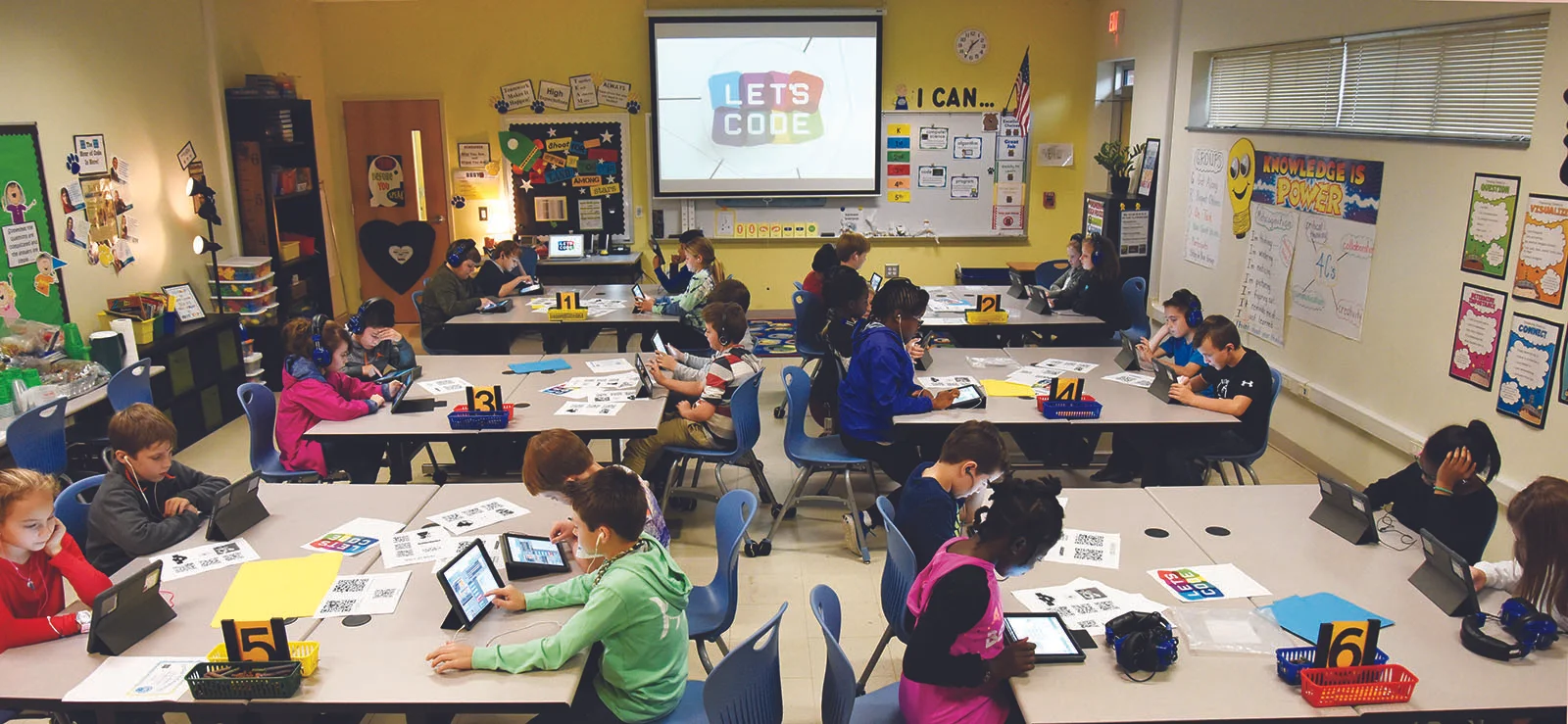
Coding instruction, exercises and contests have been popular in LCPS’s elementary and middle schools in recent years, an outgrowth of the district’s four-year-old digital learning initiative that put iPads and other Apple devices in the hands of all K-12 students and teachers. The formal curriculum introduced this school year leverages that acquaintance with coding and the district’s long association with Apple to give LCPS a head start in an instructional area school districts are scrambling to bring online.
“The biggest head start is that we already had devices,” Jones said. “The second advantage was the students were already familiar with the basic Apple products so they didn’t have to learn those things. They could focus just on the coding portion of it. Then we have a direct line to Apple for professional development. We’d already established that relationship.”
Last summer, a curriculum development team of six teachers worked with Apple consultants to customize the coding lessons built around Apple’s Swift Playgrounds. Out of that planning grew a basic coding course being taught weekly to students in middle school STEM Centers and semester-long courses in coding and app development taught online as an elective in high school.
Stephanie Harrell, the STEM Center facilitator at Contentnea-Savannah K-8 School, has a hand in it all – a member of the development team, a middle school coding teacher and coordinator and instructor for the online courses. Her secret to teaching basic coding to six graders? Get them to think in the step-by-step way of a computer.
“It goes from me giving them directions to follow to them trying to give me directions to follow,” Harrell said. “They have to realize they need to be super specific about the directions they give because if they’re not the computer is not going to follow along.”
Computer code is the “brains” behind the buttons, the lines and lines of formulas that do everything from activating and driving the apps on a smartphone to quite literally driving a modern automobile. Early coding instruction looks a lot like game playing – manipulating a character through a grid, for instance – but by the time middle schoolers become high schoolers, they are writing code and designing apps.

Moises Ramirez-Barron, in his second semester of coding instruction at Lenoir County Early College High School, will move into college-level coding classes next year as he prepares for a career as a computer engineer. Photo by Patrick Holmes / LCPS
“We start them on Swift Playgrounds because of the interface. It looks fun and is set up very much like a game,” Harrell said. “But you still have that way code is actually written out, so you have both worlds – the elementary, cartoony side of it and you also have the actual real-world code in there, so when they get ready to write their own code I think it’s as easier transition.”
Sophomores Ashlynn Holloman and Moises Ramirez-Barron skipped the transition. They’re among the more than 50 students in the first online coding and app development class, now in its second semester at all three traditional high schools and Lenoir County Early College High School. The first semester ended with students creating an app that turned their phone into a flashlight. This semester they’ll build an app that allows clients of the local hospital’s wellness center to track their workouts.
“I like that you have to think,” Moises, a student at Early College, said. “It’s not like some other courses where they give you some things to memorize and you write it down on a test. Coding actually makes you think about what you have to do.”
While middle school students code on their iPads in a classroom setting, the online students gather in their school’s media center with their MacBooks to work on instructional modules that Harrell pushes out weekly through Canvas, a document management system used system-wide. Harrell sometimes visits the high school classes to help students work through problems but mainly they communicate via email. Students work on assignments at their own pace but progress to the next module together, meaning students like Ashlynn for whom coding comes easier often take the role of tutor.
“Right now I’m done with all my assignments she’s posted now, but I don’t think my other classmates are. So I help them out and once we’re all completed she’ll post another assignment,” the 15-year-old South Lenoir High student said recently.
That’s fitting since Ashlynn plans to be a middle school math teacher, not a coder. “I don’t think of it as a career, but it’s very interesting and it’s a lot like math,” she said of coding. “It’s very logical. I think it helps your understanding. It’s very strategic because if you don’t get something then it makes you want to try to get it; then when you do finally figure out the correct formula for it, that’s such a relief.”
After two semesters in the curriculum, she plans to follow the coursework as it expands.
So does Moises, but as an Early College student – and an aspiring computer engineer – he will move into college-level coding classes next year, when he begins his pursuit of an associate degree from Lenoir Community College in earnest.
That’s a jump for a 16-year-old, but one he says he’s prepared for, in part because of the residual lessons of coding. “This class is challenging me to strive better,” he said.
“With coding there are going to be failures. The thing about coding is you can go back and see what you did wrong and fix it. You know it’s an error because the application gives you an instant error sign. You go back and look at it. You have to figure it out,” Moises said. “You basically keep on trying until you get it right. I think that belongs to everything in life.”